
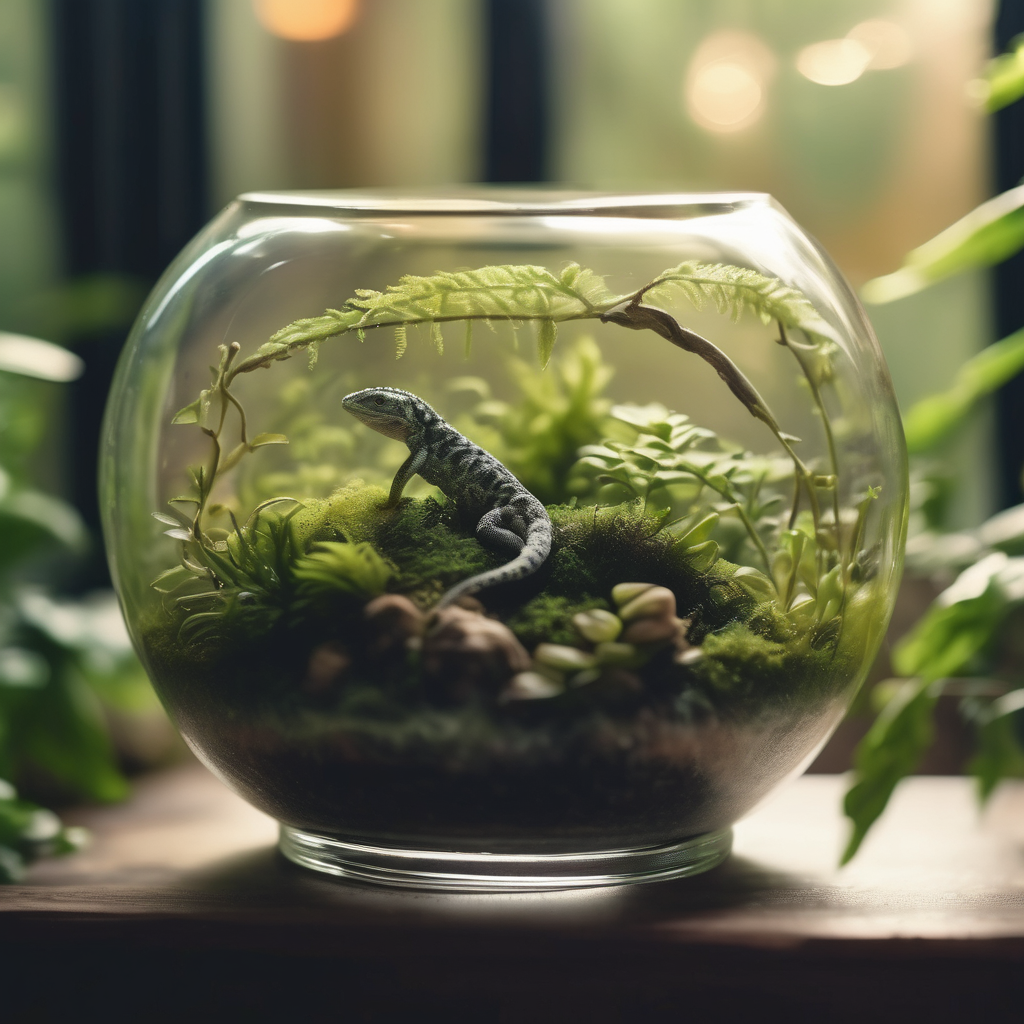
Plastic plants are easy. They are also flat, dead, and quietly dishonest — a terrarium full of silk leaves looks like a stage set, and the animal inside behaves accordingly, spending its time on open glass instead of under cover. Live plants change that. They raise humidity where you need it, hold soil structure together, give a cleanup crew somewhere to live, and give a crepuscular gecko the dappled shade it evolved under.
The catch is that live plants in a reptile terrarium are not houseplants. They are being asked to survive in an enclosure with heat lamps, a specific humidity band, an animal that walks on them, and often a substrate that drains differently from a flowerpot. Get those four things right and the plants thrive; get them wrong and you replace them every three months while blaming the species.
This guide covers which plants are genuinely safe around reptiles and amphibians, which ones actually survive common terrarium conditions, how to plant them properly, and the maintenance routine that keeps them alive. If you are still designing the enclosure itself, read our guide to reptile terrarium equipment and setup first — lighting and drainage decisions made now determine whether your plants live.
When to see a vet — warning signs in the animal, not the plants
A new planting is also a new set of hazards. Contact an exotic vet promptly if your reptile or amphibian shows any of the following after plants or new decor go in:
- Mouth swelling, excessive drooling, repeated pawing at the mouth, or refusal to open the jaws — possible contact with an irritant or a toxic sap.
- Lethargy, hiding constantly, or refusing food for more than a few days.
- Regurgitation, diarrhoea, or blood in the stool after eating plant material.
- Neurological signs: head wobble, tremors, circling, or uncoordinated movement. Our guide to neurological signs in reptiles explains what to look for.
- Skin lesions or discolouration in amphibians, whose skin absorbs chemicals directly — see our guide to amphibian health warning signs.
If you do not yet have one, our guide to choosing a vet for your reptile or exotic pet explains how to find an experienced exotics practitioner before you need one. General emergency signs are covered in how to tell if your reptile is sick.
First: safety — which plants to avoid entirely
Two categories of plant belong nowhere near a reptile or amphibian enclosure.
Acutely toxic species
These can kill an animal that chews them, and reptiles do chew — juveniles especially, and herbivorous species habitually. Keep them out of the vivarium room entirely rather than merely out of the enclosure:
- Philodendron and Monstera — calcium oxalate crystals cause intense oral burning and swelling. Frequently mistaken for pothos because the leaf shape is vaguely similar; they are not the same plant and this confusion is a common poisoning route.
- Dieffenbachia (dumb cane) — same oxalate problem, plus a sap that causes swelling severe enough to affect breathing in small animals.
- Peace lily, calla lily, and other aroids — oxalate toxicity.
- Oleander, azalea, rhododendron — cardiac glycosides, extremely toxic even in small amounts.
- Yew, foxglove, lily of the valley — cardiotoxic and best treated as never in the house.
- Any bulb plant — hyacinths, daffodils, tulips, amaryllis. Bulbs concentrate toxins and get dug up and eaten.
Chemically treated and pest-control plants
This is the underrated one. A nursery plant can carry systemic insecticide in its tissue for months, and amphibians in particular absorb those chemicals through their skin. Before anything goes into a vivarium:
- Buy from a source where you can ask about pesticide use, and prefer plants grown for terrarium use.
- Quarantine and rinse every new plant thoroughly — roots included — before planting.
- Never use household insecticide, neonicotinoid soil treatments, or fly sprays anywhere near the enclosure.
- Skip fertilizer spikes and slow-release pellets; use a weak, species-appropriate liquid feed sparingly, as covered below.
Amphibian keepers should treat plant selection with extra care for exactly this reason. Our guide to the poison dart frog bioactive setup explains the no-chemicals discipline that applies across the whole enclosure, and our guide to amphibian enclosure setup covers the drainage that planted amphibian tanks need.
Plants that genuinely work — by enclosure type
Species selection is really a matching exercise: the plant’s light and moisture needs against the enclosure’s actual conditions. The list below is ordered by how reliably keeper-proven species survive.
Desert and arid setups (bearded dragons, leopard geckos, some snakes)
This is the hardest category, because the light is intense, the humidity is low, and the substrate drains fast. Plants that survive here are genuinely tough:
- Sansevieria / Dracaena types — tolerate bright light, low water, and being trodden on. Plant in a deep pot buried in the substrate so the root ball stays dry while the leaves sit in the light.
- Aloe (small species) — thrives in bright light with almost no water. Keep it in a well-draining pocket of substrate, away from where the animal burrows.
- Haworthia and small haworthia-type succulents — compact, low-water, and unfazed by bright light.
- Ponytail palm (Beaucarnea) — survives low humidity and bright light; slow-growing, which is a feature.
- Thyme, rosemary, oregano (as potted specimens) — Mediterranean herbs love bright light and dry roots. Only appropriate if your species might browse and you are confident of the species — and never in an enclosure with an animal that eats heavily.
In arid setups, plant in buried pots rather than directly into the substrate. This keeps the root zone at the right moisture level while the rest of the enclosure stays dry, and it means you can swap a plant without disturbing the substrate. Species guides like bearded dragon setup and leopard gecko setup explain the humidity targets you are planting into.
Tropical forest setups (crested geckos, many frogs, tree-dwelling snakes)
High humidity and moderate light — the easiest category, and where live plants transform the enclosure most visibly:
- Pothos (Epipremnum aureum) — the workhorse. Grows fast, tolerates a wide light range, trails or climbs, and takes trimming without complaint. Start every planted tropical terrarium with one.
- Philodendron hederaceum (heartleaf philodendron) and other true climbing philodendrons — excellent climbers. Confirm the exact species: many Philodendron are toxic, and heartleaf is chosen precisely because it is the well-tolerated exception widely used by keepers.
- Fittonia (nerve plant) — low-growing, loves humidity, and visibly collapses when dry, giving you a free moisture indicator. Not for an animal that tramples it constantly.
- Peperomia species — compact, sturdy, tolerant of moderate light.
- Bromeliads (Neoregelia, Vriesea) — the standout choice for dart frog and tree frog enclosures. The leaf axils hold water, which frogs use as egg-deposition sites and drink from, and the plant itself adds almost nothing to the maintenance load.
- Hoya — slow, waxy-leaved climber that tolerates lower light than pothos.
- Spider plant (Chlorophytum) — tough, fast, safe, and produces runners you can split into new plants for free.
- Tillandsia (air plants) — mounted on cork bark or wood rather than planted, they need no substrate at all. Excellent for arboreal setups.
- Small ferns (button fern, bird’s nest fern, rabbit’s foot fern) — love humidity and shade. Bird’s nest fern is the most forgiving.
- Java fern and Anubias attached to wood — useful in paludarium and semi-aquatic sections where the plant base sits in water. Our guide to building a paludarium covers that transition zone.
Species guides that go deeper on these enclosures: crested gecko care, White’s tree frog care, and axolotl care for the fully aquatic case.
Semi-aquatic and paludarium setups
Only plants with a foot in water will survive the land-to-water transition:
- Pothos and philodendron trailing into the water — the classic paludarium planting. The roots in water also strip nitrates, which is why they are doing double duty.
- Java fern, Anubias, and Cryptocoryne — submerged or semi-submerged, attached to rock or wood rather than planted in gravel.
- Umbrella palm, dwarf sagittaria, and other marginal species — planted in the shallow margin.
Water quality still rules: our guide to cycling a terrarium explains the nitrogen cycle that planted aquatic sections depend on.
Amphibian terrariums
Amphibians need the highest humidity and the most cover, so plants here are structural rather than decorative. Prioritise leaf litter over plants for ground cover — our guide to choosing reptile substrate explains why — then add bromeliads, small ferns, moss, and pothos for canopy. Fire-bellied newts and tiger salamanders both benefit: see fire-bellied newt care and tiger salamander care.
Light: the thing that kills most planted terrariums
A plant that arrives healthy and dies within two months was almost always under a light that was chosen for the animal, not the plant. Heat lamps and ceramic emitters provide almost no usable light for photosynthesis. A bright-looking enclosure under a red or ceramic heat source is a dark room as far as a fern is concerned.
The solution is a full-spectrum LED plant light running 10–12 hours a day, positioned above the canopy. This does double duty: it grows the plants and provides the day-night cycle your animal needs, which is covered in our guide to the reptile day-night cycle and photoperiod. Our guide to amphibian lighting explains the UVB question in the same context, and terrarium automation covers putting all of it on timers.
Practical rules: match the plant to the light you already have rather than buying lights to suit a wishlist, and add light before adding heat if you must choose. If your enclosure is dim, plant for dim — pothos, hoya, and bird’s nest fern will all live in conditions where a fittonia will not.
Drainage and planting method
Root rot, not dehydration, is what kills terrarium plants. The standard layered build, explained in detail in our guide to bioactive terrarium layers:
- Drainage layer — 3–5 cm of LECA, gravel, or a plastic false bottom. Water must be able to sit below the substrate.
- Mesh barrier — fiberglass screen so substrate does not fall into the drainage layer.
- Substrate barrier (optional) — a thin layer of sphagnum moss stops fine soil migrating down.
- Soil mix — well-aerated, not garden soil. A common working mix: coco coir or peat-free fibric coir, orchid bark, a little horticultural charcoal, and leaf mould. Charcoal helps keep the mix sweet.
- Leaf litter top-dressing — oak or magnolia leaves. This is where your isopods and springtails live and work.
Planting method matters as much as the mix. Remove as much of the nursery potting medium as you can gently, tease the roots apart, and plant into the soil layer so the root ball sits at the correct depth. For climbers like pothos and philodendron, push a piece of cork bark or a branch into the substrate and train the vine onto it — the plant will attach its aerial roots and climb, which is exactly what gives an arboreal gecko a shaded route to the top. Our guide to escape-proofing a terrarium covers making sure added wood does not become a ladder.
Maintenance: keeping them alive
Watering
Water lightly and evenly rather than flooding one spot. The drainage layer exists so the plant roots can draw from it between waterings. In a humid tropical enclosure with a well-managed humidity level, you may only need to mist every few days; in an arid setup with potted succulents, the plant should be watered as a separate item, not by the enclosure’s misting schedule. Over-misting an arid setup to keep a plant alive is how you end up with scale rot instead.
Feeding
Fertilise at quarter strength, infrequently, with a balanced liquid feed. In a bioactive setup, the isopod and springtail colony plus your animal’s waste provides most of what the plants need — heavy feeding is usually unnecessary and risks chemical exposure in amphibians. Never use fertiliser spikes or slow-release pellets anywhere an amphibian can contact them.
Pruning and training
Pothos and philodendron will try to take over the enclosure. Trim them back monthly and use the cuttings to propagate new plants — cuttings root in a glass of water within two weeks and cost nothing. Keeping growth controlled also keeps sightlines open so you can actually see your animal during health checks, which our guide to cleaning a reptile tank depends on.
Pests
Fungus gnats are the usual complaint and are a symptom of constantly wet soil. Let the top centimetre dry between waterings, and if the population persists, add a sticky trap at soil level and increase springtail numbers — they eat gnat larvae. Never apply insecticide. Scale, mealybug, and spider mite should be removed manually with a damp cotton bud and quarantined plants.
Mould and algae
White fuzz on the soil surface is usually harmless saprophytic fungus, cured by airflow and letting the surface dry. Green algae on glass is a light-level signal — either too much light or too little water movement.
Replacing plants
Remove any plant that is dying rather than leaving it to rot in the enclosure. A rotting root ball in a warm, humid terrarium goes foul fast and drags the soil chemistry down. Replace it with a cutting you have already rooted, which is why keeping a propagation jar is part of the routine.
Frequently asked questions
Are pothos safe for reptiles?
Pothos is the most widely used plant in planted terrariums and is well tolerated by reptiles and amphibians, including species that occasionally browse. It is not food — no common terrarium plant is a substitute for a proper diet — but incidental contact and nibbling are not a poisoning risk. Our guides to gut-loading and dusting feeder insects and feeding amphibians cover what your animal should actually be eating.
Can I use plants from a garden centre directly?
Not without preparation. Rinse the leaves and roots thoroughly, remove nursery potting medium, and check for pests. Ideally quarantine the plant for a week or two somewhere warm and humid — which a spare terrarium or a covered propagator does perfectly — so you can see problems before they are inside the animal’s enclosure.
Do live plants reduce the amount of cleaning I need to do?
In a bioactive setup, yes, meaningfully. A healthy plant root system plus a cleanup crew consumes waste and stabilises moisture, so spot-cleaning becomes lighter. It does not eliminate cleaning — the weekly and monthly tasks in our cleaning schedule guide all still apply.
Will my bearded dragon eat the plants?
Bearded dragons eat significant plant matter as part of a correct diet, so plants in a bearded dragon enclosure will be consumed. That is fine if the plants are safe species, but it means you should plant for replacement rather than for permanence. Our guide to bearded dragon care covers the greens that belong in the diet rotation.
Do I need a grow light, or will my heat lamp do?
You need a grow light. Heat lamps and ceramic emitters emit very little photosynthetically useful light, and red or moonlight bulbs emit none. A full-spectrum LED running on a timer is the minimum, and it also gives your animal the day-night contrast covered in our photoperiod guide.
How do I stop pothos from taking over the whole tank?
Trim it. Monthly trimming with the cuttings kept for propagation keeps the canopy where you want it. Train it along one back corner rather than letting it ramble, and remember that visible animals are healthier animals — a jungle you cannot see into is a welfare problem as well as an aesthetic one.
My plant keeps dying even though I water it. What is wrong?
Almost always one of three things: no drainage layer, a soil mix that holds too much water, or insufficient light. Check in that order. Adding drainage is the single highest-impact fix.
Are moss and leaf litter worth adding?
Yes, in almost every setup. Leaf litter on the surface feeds the cleanup crew, holds humidity at soil level, and gives ground-dwelling species cover — and amphibians in particular benefit. It is not strictly a “plant” but it belongs in the same planting plan. See our guide to choosing reptile substrate.
A planting checklist
Before you buy
- Confirm your enclosure’s actual light output and humidity range, and choose plants to match — not the reverse.
- Check every candidate species against the toxic list above.
- Buy from a source that can tell you what was sprayed.
Before planting
- Build the drainage layer and mesh barrier if the enclosure does not already have them.
- Prepare an aerated soil mix; do not use garden soil.
- Rinse and strip nursery medium from every plant; quarantine anything suspicious.
- Attach climbing material — cork bark, branches — before the plants go in.
After planting
- Put the full-spectrum LED on a timer, 10–12 hours daily, matching the animal’s photoperiod.
- Add the cleanup crew — our isopod and springtail guide covers how many for a given tank size.
- Top-dress with leaf litter.
- Set a calendar reminder for monthly trimming and a weekly visual check for pests and mould.
- Keep a propagation jar going so a dead plant is a five-minute fix.
Weekly check
- Soil moisture: damp, not sodden. If it is sodden, increase airflow and reduce misting.
- Plant condition: yellowing, crispy edges, or collapse all point to a specific fixable problem.
- Pests: look under leaves, not just at them.
- Animal visibility: if you cannot see your reptile for a health check, the planting is too dense.
The bottom line
Live plants are the single biggest upgrade you can make to a reptile or amphibian terrarium, and the reason most attempts fail is that they are chosen like houseplants and planted like houseplants. Match the species to your actual light and humidity, build drainage before you build anything else, avoid the six toxic families outright, and keep the plant load light enough that you can still see your animal.
Do that and the enclosure stops being a display case and becomes a habitat — cooler in the shade, more humid under the canopy, and full of the small movement that keeps an animal behaving like an animal.
Leave a Reply