
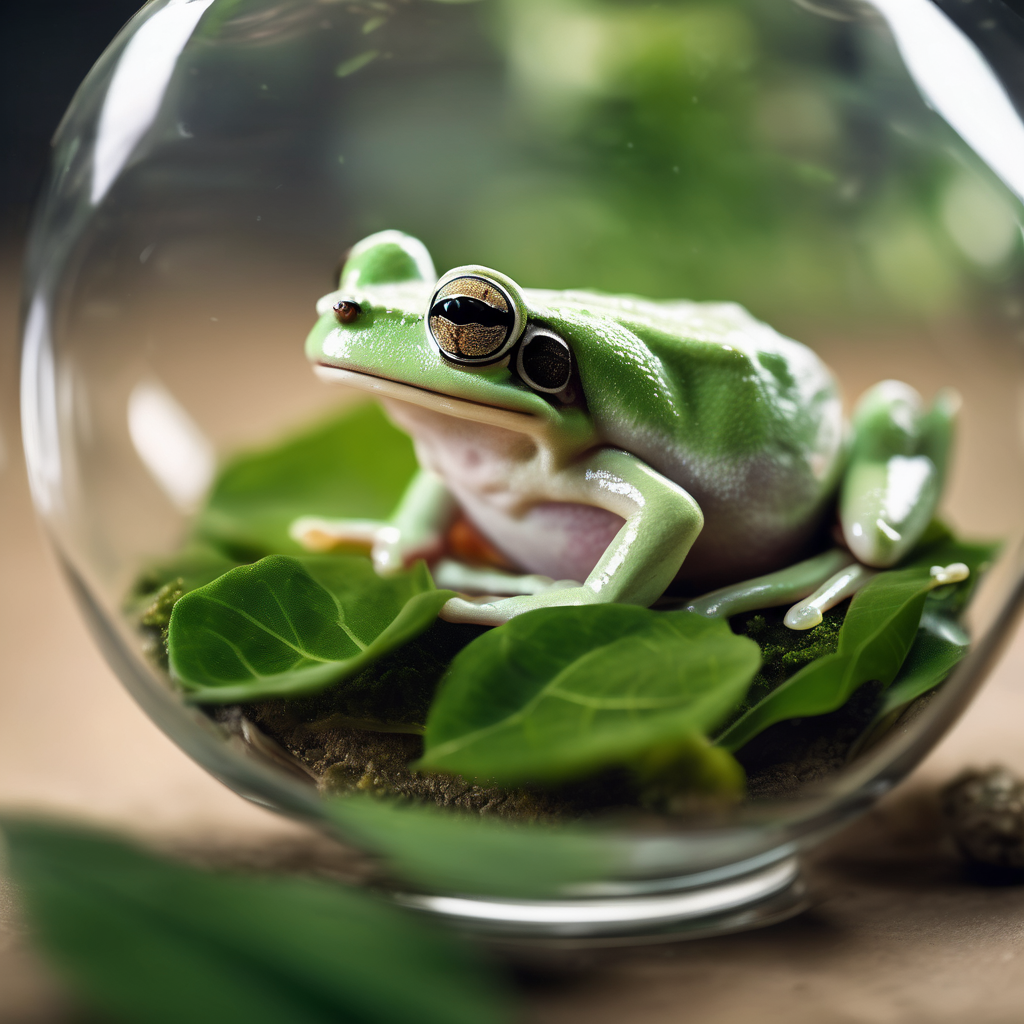
The White’s tree frog is the amphibian most often recommended to a first-time keeper, and the reason is simple: it is large, it is calm, it tolerates ordinary room humidity far better than a dart frog, it eats from tongs, and it lives for fifteen to twenty years. It is also the species most often killed by its owner’s kindness. This is a chunky Australian frog that will sit in a water dish for eight hours a day, and a keeper who reads that as “it loves water” will flood it into a red-leg infection, while a keeper who reads the calm temperament as “it is fine” will run a bone-dry tank and watch it desiccate. This guide covers what a White’s tree frog actually needs: enclosure size and orientation, temperature, humidity that swings rather than sits, lighting, substrate, water, feeding, handling, and the specific failure modes that kill them. If you are still choosing between species, our beginner frog comparison is the faster read.
Species basics
- Scientific name: Litoria caerulea (formerly Ranoidea caerulea)
- Common names: White’s tree frog, dumpy tree frog, Smoky frog (in the Australian trade)
- Adult size: 3-4.5 inches (8-11 cm); females are noticeably larger and rounder
- Lifespan: 15-20 years in captivity, with 25 recorded
- Native range: Northern and eastern Australia and southern New Guinea; introduced to Florida and New Zealand
- Temperament: Docile, diurnal-adapted but often active at night, surprisingly tolerant of gentle handling for an amphibian
- Beginner suitability: High, provided the humidity and temperature ranges are actually respected
They are called dumpy frogs because they genuinely look sleepy and overweight even when healthy. Do not use body shape to judge condition in this species; use body condition over months and eye clarity, not roundness. The broad care framework that applies to every amphibian you might own is in our complete amphibian care guide.
Enclosure: orientation matters more than volume
White’s tree frogs are arboreal-ish terrestrial: they climb, but they spend a lot of time on the floor and in the water dish. That means you want an enclosure with more floor area than height, and enough climbing structure to use the upper third.
| Number of frogs | Minimum enclosure | Notes |
|---|---|---|
| 1 adult | 18 x 18 x 18 in (exo terra 18) | Absolute floor for a single adult |
| 1 adult (recommended) | 18 x 18 x 24 in or a 20-gallon long | Lets you fit a real water dish and climbing branches |
| 2 adults | 36 x 18 x 18 in | Females cohabit well; males are territorial and vocal |
| 3+ adults | 48 x 18 x 18 in | Feed individually to make sure each frog eats |
A 10-gallon tank is widely sold as “fine” for this species and it is not, once the frog is adult. The horizontal footprint is the constraint: a 10-gallon simply has no room for a water dish large enough to soak in plus a hide plus a feeding area.
What to put in it
- A large, shallow water dish. This is the single most important piece of furniture. It must be deep enough for the frog to submerge fully (2-3 inches) and wide enough for an adult to sit in without its hips riding the rim. Frogs absorb water through their skin and will spend hours in it.
- Cork bark or branches to reach the upper half of the tank. Keep climbing routes at least one body-width apart.
- Two hides. One on the warm side, one on the cool side, so the frog can thermoregulate and feel secure at the same time.
- Live or artificial plants. Broad-leafed pothos, philodendron, and bromeliads all work. They provide cover and they raise local humidity around the frog.
The general layout logic, screen top versus glass top, and background choice are covered in our amphibian enclosure setup guide. If you want a planted build with a drainage layer, the technique is in our bioactive setup guide, though note that White’s tree frogs tolerate a drier, simpler setup than dart frogs and do not need a full bioactive build.
Cohabbing
Females are generally safe together in a properly sized tank. Two adult males in anything under 4 feet will vocalise at each other constantly and the subordinate will stop eating. Males are identifiable by a grey, wrinkled vocal sac under the throat when calling. Never house this species with fish, and never with other amphibians: White’s tree frogs will eat anything that fits in their mouth, and larger tankmates will stress them.
Temperature
These frogs tolerate a wide range by amphibian standards, which is a large part of why they suit beginners, but there is a hard ceiling.
- Daytime: 75-82°F (24-28°C)
- Night-time drop: 5-8°F below daytime is normal and healthy
- Acceptable short-term floor: 65°F, but not as a permanent condition
- Hard ceiling: 85°F (29°C). Above this, frogs become distressed quickly and can die within hours
In most temperate homes, a room at 72-76°F is enough and you need no heat source at all. If your room drops below 68°F overnight in winter, use a low-wattage heat mat on one side wall, controlled by a thermostat set to 78°F. Never put the mat under the tank: these frogs lie on the floor, and a hot substrate spot is a burn risk for an animal with permeable skin. Side-wall heat plus a thermostat is the standard answer, explained in our thermostat guide.
Verify with a digital probe thermometer placed at frog level, not at the top of the tank where the air is several degrees warmer. The measurement technique that actually catches problems is in our thermometer and hygrometer guide.
Humidity: the part everyone gets wrong
The internet says “70% humidity” and keepers dutifully hold the tank at a constant 70%. That is not what these frogs live in, and it is the most common path to a skin infection. In their native range, the humidity swings through the day and through the seasons, and a constant clammy tank produces chronic bacterial and fungal skin disease.
- Day: 50-60% relative humidity, ventilated
- Night and after misting: 70-85%
- Never below 40% for more than a few hours
- Never saturated and still for days
The cycle matters more than the average. A screen top on a glass tank gives you this naturally: the air dries during the day and the frog retreats into the water dish or a damp hide, then you mist in the evening and the whole tank rises for the night. If your enclosure is fully sealed, it will run too wet and you will need to open a vent panel.
Buy a calibrated digital hygrometer and place it at frog level in the middle of the enclosure. Cheap analog gauges are routinely 20 points out and are worse than no gauge. Humidity management across all species, including how to raise it safely without flooding the substrate, is in our humidity control guide.
Lighting
White’s tree frogs are primarily nocturnal and are generally considered low-UVB-tolerant, but they still benefit from low-level UVB, and they absolutely need a day/night cycle to stay healthy.
- A 12/12 day/night cycle, ideally on a timer. Photoperiod drives appetite, immune function, and breeding behaviour; the reasoning is in our photoperiod guide.
- Low-output UVB (5.0 or the shaded-output “forest” bulb), 10-12 hours a day. This species does not need the high-output desert bulbs and can be overexposed by them. UVB supports vitamin D3 synthesis and calcium metabolism; without it, metabolic bone disease develops, as covered in our MBD guide.
- A visible plant light if you are keeping live plants. A full-spectrum LED on 10-12 hours is enough for pothos and philodendron.
- Never place the tank in direct sunlight. A glass tank in a window will cook the frog in twenty minutes on a warm day.
The species-specific details of what UVB does, which animals need it, and how to mount the bulb at the right distance are in our UVB lighting guide.
Substrate and floor
Two acceptable approaches, and one you should never use.
- Simple and recommended for beginners: moist paper towel or reptile carpet, replaced weekly. It is easy to clean, it shows waste immediately, and it removes impaction risk entirely. It looks less natural; the frog does not care.
- Natural and attractive: coconut fibre or a bioactive mix topped with leaf litter and moss, kept moist but not sodden, with a drainage layer underneath if you are planting.
- Never use: loose gravel, sand, calcium sand, or walnut-shell bedding. Frogs eat with their tongues and often ingest substrate along with prey; gravel and sand both cause fatal impactions. Species-specific bedding trade-offs are in our substrate guide.
If you use soil, spot-clean waste weekly and replace the top layer every two to three months. Amphibians absorb chemicals through their skin, so do not use scented or antibacterial cleaners anywhere near the enclosure. Our amphibian tank cleaning guide lists what is and is not safe.
Water quality
Amphibians do not drink through their mouths; they absorb water through a patch of skin on the belly and thighs called the drinking patch. That means whatever is in the water goes directly into the frog, which is why tap water chemistry matters far more for amphibians than for reptiles.
- Dechlorinate every time. Chlorine and chloramine are absorbed through the skin and are acutely toxic. Use a reptilian/aquarium dechlorinator, or let tap water stand 24 hours with aeration for chlorine only.
- Change the water dish daily. These frogs defecate in their water dish, reliably. A dish changed every three days is a bacterial soup.
- Keep the dish shallow at one edge so a frog can climb out if it becomes weak. A dish with a sheer 3-inch rim can drown a sick animal.
- Temperature-match the water to the room. Cold water on a warm frog is a shock.
If you keep a paludarium with standing water rather than a dish, the filtration and cycling requirements apply in full; see our amphibian water quality guide.
Feeding
What to feed
- Staples: crickets, dubia roaches, and appropriately sized locusts. Aim for prey no wider than the space between the frog’s eyes, and no longer than the frog’s body.
- Treats: waxworms and mealworms occasionally only. Waxworms are very high-fat and a staple diet of them produces obesity.
- Supplements: dust every feeding with a calcium supplement containing vitamin D3 if you are not running strong UVB, and once or twice a week with a multivitamin.
How to dust properly and how to gut-load feeder insects is in our feeder insect guide. This species is famous for eating so enthusiastically that it will take food from tongs within days of arriving, which is one of the reasons it suits beginners. The amphibian-specific feeding schedule is in our amphibian feeding guide.
How much and how often
- Juveniles (under 6 months): daily, as much as they will eat in 10-15 minutes
- Adults: 4-6 appropriately sized insects every second or third day
- Obesity is the number one diet-related problem in this species. An adult frog does not need daily feeding. If you can see fat deposits over the eyes or the frog is rounder than a clenched fist for its length, cut back.
Feed in the evening or at lights-out, when the frog is naturally most active. Feed from tongs or in a shallow dish, and remove uneaten crickets overnight: crickets will nibble a resting frog’s skin and eyes.
Handling
White’s tree frogs tolerate handling better than most amphibians, and that tolerance is exactly why they get over-handled.
- Amphibian skin is permeable. Soap residue, hand lotion, sunscreen, and even clean-but-dry human skin will dehydrate and irritate them. Wet, clean, chemical-free hands only.
- Keep sessions to 10-15 minutes maximum, and not more than a couple of times a week. Dry air is the risk: a frog out of the tank for half an hour is losing water to the room the whole time.
- Never grab. Coax the frog onto your hand and let it step across; if it resists, stop.
- Do not handle a frog that is shedding, and do not handle one that has red legs, open sores, or cloudy eyes.
The full when-to-touch and when-absolutely-not-to guidance is in our amphibian handling guide. If children are involved, supervised handling once a week is the right ceiling.
Warning signs and health
Environmental warning signs first
Before you assume illness, check the readings. In this species, most “illness” is an environment problem wearing a medical mask.
- Frog spending all day buried under a hide or pressed into a corner: too bright, too hot, or too dry.
- Frog sitting in the water dish continuously: too dry or too hot in the enclosure.
- Constant calling from a male: usually breeding behaviour, but also worth checking temperature.
- White, cloudy, or stringy substrate film, or the dish going slimy in a day: overfeeding and under-cleaning.
Medical red flags
- Red-leg (bacterial dermatosepticemia): reddening on the underside of the legs and belly. This is a veterinary emergency, not a home fix. It is almost always caused by water or substrate that has been dirty, or a tank running too cold and too wet.
- Cloudy or sunken eyes: dehydration or a nutritional/metabolic problem. A frog with sunken eyes and loose skin is in trouble within days.
- Refusing food for more than two weeks in an otherwise healthy-looking frog: check temperature, humidity, and UVB first, then book a vet appointment. An amphibian that stops eating for a month has a serious underlying problem.
- Abnormal shedding: stuck shed on the toes or over the eyes, usually from humidity that is too low. Do not peel it off; raise the humidity and let it come away.
- Swollen, firm abdomen: can be impaction from substrate, egg-binding in a female, or organ disease. All three need a vet.
- Sores, ulcers, or white cottony patches on the skin: fungal infection, usually secondary to chronic damp or an untreated injury.
- Unusual lethargy with a gaping mouth: potential respiratory infection, often from chronic damp combined with poor airflow.
The complete preventive and veterinary picture for amphibians is in our amphibian health guide. Take a photo of the frog, a photo of the enclosure, and your temperature and humidity readings to the appointment: an amphibian vet will ask for all three, and having them changes the diagnosis speed. Before bringing a new frog home, run the quarantine protocol, because a new animal in an established tank is the usual source of the problems above.
Frequently asked questions
Do White’s tree frogs need a water dish or a full aquatic setup?
A large, shallow, daily-changed water dish. They are not an aquatic species and will not thrive in a deep-water setup, but they will absolutely soak for hours a day and need the option.
Can I keep one on paper towels forever?
You can, and it is a defensible long-term choice that removes impaction risk and makes cleaning trivial. Many experienced keepers keep White’s tree frogs on paper towel or a bioactive mix interchangeably. The frog’s health is driven by temperature, humidity, and diet, not by how natural the floor looks.
Do they croak a lot?
Males croak, loudly, usually at night and often in the breeding season. It sounds like a deep bark or a motorbike. It carries through a wall. If noise matters, a female is the better choice.
How long can they be left alone?
Three to four days with a full water dish is fine for a healthy adult. A week is not, and a holiday where the tank runs too hot because a heat mat failed is the classic way to come home to a dead frog. Use a power outage plan and a thermostat with an alarm if you travel regularly.
Do they need UVB if they get dietary D3?
Low-level UVB is still the better option even with a good supplement, and it is the only way to let the frog regulate its own D3 production. If you use UVB, keep the output low and provide shade so the frog can choose.
Are they good with other frogs?
Females cohabit fine. Mixed species do not: White’s tree frogs eat smaller frogs, and dart frogs will be stressed into the ground by an animal ten times their size.
Setup checklist
- [ ] Enclosure: 18 x 18 x 24 in minimum for one adult, front-opening, screen top
- [ ] Digital probe thermometer at frog level, 75-82°F day, 5-8°F night drop
- [ ] Thermostat-controlled side-wall heat mat if the room runs below 68°F
- [ ] Calibrated digital hygrometer at frog level; day 50-60%, night 70-85%
- [ ] 12/12 photoperiod on a timer, low-output UVB (5.0 forest) 10-12 hours
- [ ] Large shallow water dish, 2-3 inches deep, with one climbable edge
- [ ] Two hides (warm side and cool side) plus cork bark climbing routes
- [ ] Live or artificial plants for cover and local humidity
- [ ] Substrate: paper towel / reptile carpet, or moist coconut fibre with a drainage layer
- [ ] Dechlorinator on hand; water dish changed daily
- [ ] Calcium with D3 plus a weekly multivitamin, dusting station set up
- [ ] Appropriately sized feeders (no wider than the gap between the eyes)
- [ ] Feeding tongs; uneaten crickets removed overnight
- [ ] Enclosure out of direct sun and away from draughts, per our placement guide
- [ ] Exotic vet located and number saved before you need it
- [ ] New animals quarantined for 30-60 days before entering an established tank
The bottom line
A White’s tree frog is close to the ideal first amphibian: tough, calm, eats from tongs, and lives for two decades. It rewards the keeper who understands two things and ignores the rest: the humidity must swing rather than sit at one number, and the frog must always be able to get into deep water. Give it a room-temperature enclosure, a big water dish changed daily, a day/night light cycle, and correctly dusted prey every second day, and it will thrive for twenty years. Flood it into a constant clammy tank or bake it at 88°F and it will be gone in a month, for reasons that look mysterious and are not. The wider context on species choice, setup, and seasonal variation is in our complete amphibian care guide.
Leave a Reply