
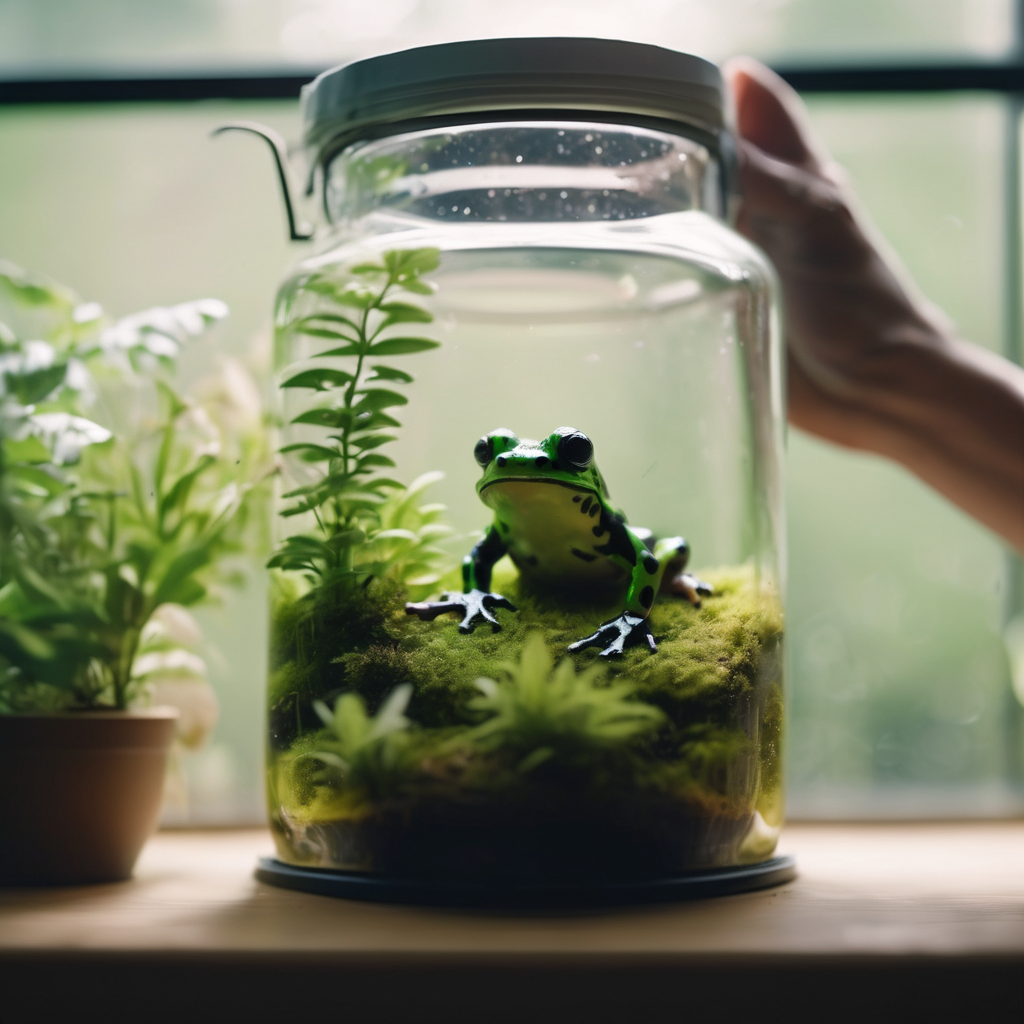
Amphibians are the hardest common pet to clean around. Their skin is permeable — it absorbs water, and with it, dissolved chemicals — so the entire reptile-keeping cleaning toolkit is wrong for a frog tank. Bleach, vinegar, quaternary ammonium disinfectants, and most pet-safe cleaners are all toxic through skin contact in a way they never are for a lizard. Every cleaning decision in an amphibian enclosure starts from that one fact.
This guide covers what is actually safe, the daily and weekly routine that keeps water stable, how to do a deep clean without crashing the tank, and the cleaning-related mistakes that make amphibians sick. Part of the pet amphibian care series.
Why Amphibian Cleaning Is Different
A reptile sheds and its scales form a barrier. An amphibian drinks and partly breathes through its skin, and anything in the water or on the glass it touches enters its bloodstream directly. This has three practical consequences:
- Residues matter more than concentration. A faint bleach film on rinsed glass can sicken a dart frog that a gecko would ignore. Rinsing must be thorough enough that no smell remains at all.
- Temperature changes are dangerous. Amphibians cannot thermoregulate by moving between a hot and cool zone — they are stuck with whatever the water is. A tank refilled with cold tap water after cleaning is a shock event, not just a preference. Always match the new water to the tank temperature within a couple of degrees.
- Water chemistry instability is the biggest risk of all. A partial water change with un-dechlorinated water can crash a cycled tank’s biology, and a sick amphibian from chlorine exposure is the classic new-keeper mistake. See amphibian water quality testing for the parameters and cycling basics that cleaning must not disturb.
What You Can and Cannot Use
Safe
- Hot water and a clean cloth or paper towel. For 90% of amphibian tank cleaning this is all you need — algae on glass, biofilm on décor, water film on the lid.
- A dedicated reptile-safe glass cleaner used OUTSIDE the enclosure only, on the outer panes, wiped off immediately. Never inside where an animal can contact it.
- Plain unscented soap for tools only — nets, buckets, turkey basters, tongs — rinsed until no slipperiness remains and stored dry, away from any cleaner.
- Dedicated amphibian-safe habitat cleaner (unscented, no bleach, no quats, explicitly labelled safe for amphibians) for the rare hard-surface disinfect, followed by a thorough rinse and full dry.
Unsafe — never inside an amphibian enclosure
- Bleach in any concentration that touches surfaces an animal can reach. Even heavily diluted residue is absorbed through skin.
- Vinegar or citric acid cleaners — commonly recommended for reptile tanks, toxic to amphibians and catastrophic for pH stability in a planted setup.
- Windex, glass cleaner, or household disinfectant sprays, on any surface, including the outside of the glass where condensation can run inside.
- Any product with fragrance, essential oils, or “fresh scent” — volatile compounds that accumulate in a humid enclosure.
- Boiling water on décor that will return to the tank unless it can be cooled and dried fully — thermal shock to the décor is fine but the steam and heat on a returning item is not the issue; incomplete drying reintroduces pathogens. Bake or boil décor off the animal, cool completely, dry completely, then return.
Cross-reference the reptile-keeping version of this at reptile tank cleaning — the schedule is similar, the chemistry rules are not.
The Daily Routine (5 Minutes)
Daily maintenance is what makes everything else easy. Do it at roughly the same time each day so the animals’ activity cycle is not disrupted:
- Feed and remove uneaten food within 15–20 minutes for aquatic species (dwarf frogs, axolotls) or check for hidden prey in terrestrial setups. Uneaten prey is the number one source of ammonia spikes and fly problems.
- Spot-remove waste and shed skin with a turkey baster or small net — siphon it from the substrate surface in aquatic tanks, lift it out with damp tweezers in terrestrial ones. Do not stir the substrate doing it.
- Top off evaporated water with dechlorinated, temperature-matched water. Evaporation concentrates everything else, so a daily top-off is better than letting the level drop and then dumping in a large change.
- Check the animals. Count them. In a planted bioactive with microfauna, a frog you cannot see is normal; a frog you could see yesterday and cannot today is a problem.
- Wipe condensation off the lid so it does not drip cold water onto a basking animal in a paludarium setup.
Temperature matching matters: keep a jug of dechlorinated water at room temperature next to the tank so the top-off is never more than a degree or two off. Sudden temperature drops are one of the most common causes of stress-related illness in amphibians.
The Weekly Routine (20–30 Minutes)
Water change: 25–30%
Match the new water to the tank in temperature and chemistry. For a semi-aquatic or paludarium setup, change the water section and mist the land section; for a fully aquatic setup, siphon from the bottom during the change to pull detritus out of the substrate at the same time. Never change more than 30–50% at once — large swings stress the animals and crash the biofilter. The full water-change philosophy for aquatic amphibian setups is covered in amphibian water quality.
Algae and glass
Wipe the inside glass with hot water on a clean cloth or a dedicated magnetic algae scraper. For planted bioactive setups, algae on the glass is normal and partially desirable — clean only the front pane if you want a viewing window, and leave the sides for the cleanup crew. Nerite or ramshorn snails in the water section of a paludarium handle algae mechanically, which is safer than scraping around plants with animals hiding in them.
Substrate check
In terrestrial setups, press the substrate — it should feel like a squeezed-out sponge, not dripping and not dusty. Too wet and you get bacterial blooms and mold; too dry and frogs desiccate and bury. Adjust misting frequency, not just volume, to fix it. See humidity control for how misting schedules and ventilation interact.
Remove dead plant matter
Yellowing leaves and rotting leaf litter in the water section are ammonia sources. Pull them out weekly. Do not wait for the cleanup crew — springtails and isopods in the land section handle dry litter, but submerged rot is chemistry you do not want.
The Deep Clean (Every 4–8 Weeks)
This is the one that goes wrong most often, because new keepers strip everything, scrub everything with cleaner, and restart the tank from zero — which kills the established biology the animals depend on. The correct deep clean removes waste without removing life:
- Move the animals first. Into a holding container with water from their own tank, temperature-matched, with a lid and something to hide under. Do not use a bucket of fresh tap water — see the warning signs section below for why that is an emergency.
- Drain the tank into buckets. In a cycled aquatic setup, keep some of the old water to return — it carries your biofilter.
- Clean the substrate gently. Siphon detritus from the top layer of gravel or soil; do not uproot plants or strip the whole bed. In a bioactive setup, the soil and its microfauna are the filtration system — treat them as the most valuable thing in the tank.
- Rinse décor in hot water only — no cleaners unless they can be fully dried and the smell is gone. Scrub algae off rocks and wood with hot water and a brush, not chemicals.
- Wipe the glass and frame with hot water. Vinegar goes on the outside of the glass only, wiped dry, if hard water spots are a problem.
- Return the substrate, décor, and the reserved old water first, then top up with dechlorinated, temperature-matched fresh water.
- Check pH and temperature before returning the animals, and acclimate them slowly — float the container, add tank water gradually over 20–30 minutes. See amphibian enclosure setup for what a correct environment looks like before you rebuild it.
For a fully bioactive dart frog setup — where the clean-up crew is doing the work — the deep clean is closer to a trim-and-tidy than a strip-down. The poison dart frog bioactive setup guide covers how a mature bioactive is maintained rather than cleaned.
Species-Specific Notes
- Aquatic frogs (African dwarf frogs, clawed frogs) and axolotls — behave much like a fish tank: weekly 25% water changes with gravel vacuuming are the backbone of maintenance. Axolotls are messier than most fish and need the same attention. The axolotl guide at axolotl care for beginners covers their specific water quality needs.
- Terrestrial dart frogs — the tank is a miniature ecosystem: misting, leaf litter turnover, and plant trimming, with water changes limited to a water dish and drainage layer. Never strip the leaf litter completely; it is their substrate and food source.
- Salamanders and newts — semi-aquatic setups with a water section that still needs the weekly siphon treatment; newts are tolerant but sensitive to ammonia. Fire-bellied newts do fine with the routine in fire-bellied newt care.
- Tadpoles — the most sensitive stage of all. Water changes must be gentle and matched in temperature and chemistry; the tadpole rearing guide covers their water needs specifically.
Warning Signs: When Cleaning Went Wrong
Amphibians deteriorate fast when water chemistry or temperature shifts. These signs within 24–48 hours of a clean mean the cleaning itself caused a problem:
- Lethargy, floating at the surface, or a frog sitting in the water dish all day. Classic response to chlorine exposure or a temperature crash. Test the water immediately for chlorine/chloramine.
- Red, inflamed skin, or cloudy skin. Chemical burn or bacterial infection from residue. This is an urgent vet visit — see amphibian health warning signs.
- Cloudy water within a day of a deep clean. A bacterial bloom from disturbing the substrate too aggressively or from overfeeding. Reduce feeding, check ammonia, do a partial change with conditioned water.
- Ammonia above zero. Cleaning stripped the biofilter. Do a 50% change with dechlorinated water, stop feeding for a few days, and re-test daily until it clears.
- A frog that was eating and now refuses food for more than a few days after a clean. Stress or water chemistry — review what changed and correct the most likely variable first (temperature, then chemistry).
Get a test kit before you get the animals. “The water looks clean” is meaningless in an amphibian tank; ammonia and nitrite are invisible at the concentrations that kill frogs. The parameters and their targets are in amphibian water quality.
Frequently Asked Questions
Can I use vinegar to remove hard water spots from the outside of the glass?
Yes — outside surfaces only, wiped thoroughly dry, with ventilation afterwards so no fumes accumulate near the enclosure. Never on surfaces the animals touch, and never inside.
How often should I do a full water change in an aquatic frog tank?
Never a full change in one go for a cycled tank — do 25–30% weekly. A full strip-down restarts the nitrogen cycle and is stressful. Reserve full teardowns for emergencies like contamination or a dead animal discovered late.
Is tap water safe if I let it sit out for 24 hours?
Only if your water utility uses chlorine alone. Chloramine — increasingly common — does not off-gas, and it requires a dechlorinator. Use a water conditioner labelled for amphibian or aquarium use every time, regardless of how long the water sat.
My bioactive terrarium has springtails. Do I still clean it?
Yes, but lightly. Wipe glass, remove obvious waste, trim dead leaves, top off the drainage layer if water pools. The springtails, isopods, and microfauna are doing the deep cleaning — disturbing the soil undoes their work and crashes the system.
Do I need to remove the frogs for a 25% water change?
No. They can stay in for a routine partial change as long as the new water is dechlorinated and temperature-matched. Only move them for a full deep clean.
How do I clean the water dish in a dart frog enclosure?
Rinse it in hot water weekly, scrub gently, and refill with dechlorinated water. Frogs soak and some absorb water through their skin from the dish, so it needs the same chemistry care as the rest of their water.
Checklist
- Daily: remove uneaten food within 15–20 minutes
- Daily: spot-remove waste and shed skin without disturbing substrate
- Daily: top off with dechlorinated, temperature-matched water
- Daily: count the animals; check the lid for drip risk
- Weekly: 25–30% water change, gravel vacuum in aquatic setups
- Weekly: algae wipe with hot water only
- Weekly: substrate moisture check (damp sponge, not dripping or dusty)
- Weekly: remove dead plant matter and rotting leaf litter from water
- Every 4–8 weeks: deep clean — animals to holding water first, reserve old water, no chemical cleaners inside
- Dechlorinator used for every single water change, no exceptions
- Water conditioner labelled amphibian-safe (no dyes, no slime-coater additives where avoidable)
- Dedicated cleaning tools stored separately from any household cleaner
- Test kit on hand: ammonia, nitrite, nitrate, pH — check before and after every deep clean
- Exotic vet contact saved before it is needed
The Bottom Line
Cleaning an amphibian tank is less about scrubbing and more about restraint. Hot water, a dedicated tool set, dechlorinated temperature-matched water, and a light touch with the substrate will keep a frog tank healthy for years; bleach, vinegar, glass cleaner, and enthusiastic deep cleans will sicken the animals no matter how clean the tank looks afterwards. Do the daily five-minute pass, the weekly 25% change, and a gentle deep clean every couple of months that preserves the biology instead of resetting it. Amphibians absorb their environment — the cleaning routine is where that fact either protects them or quietly kills them.
Leave a Reply