
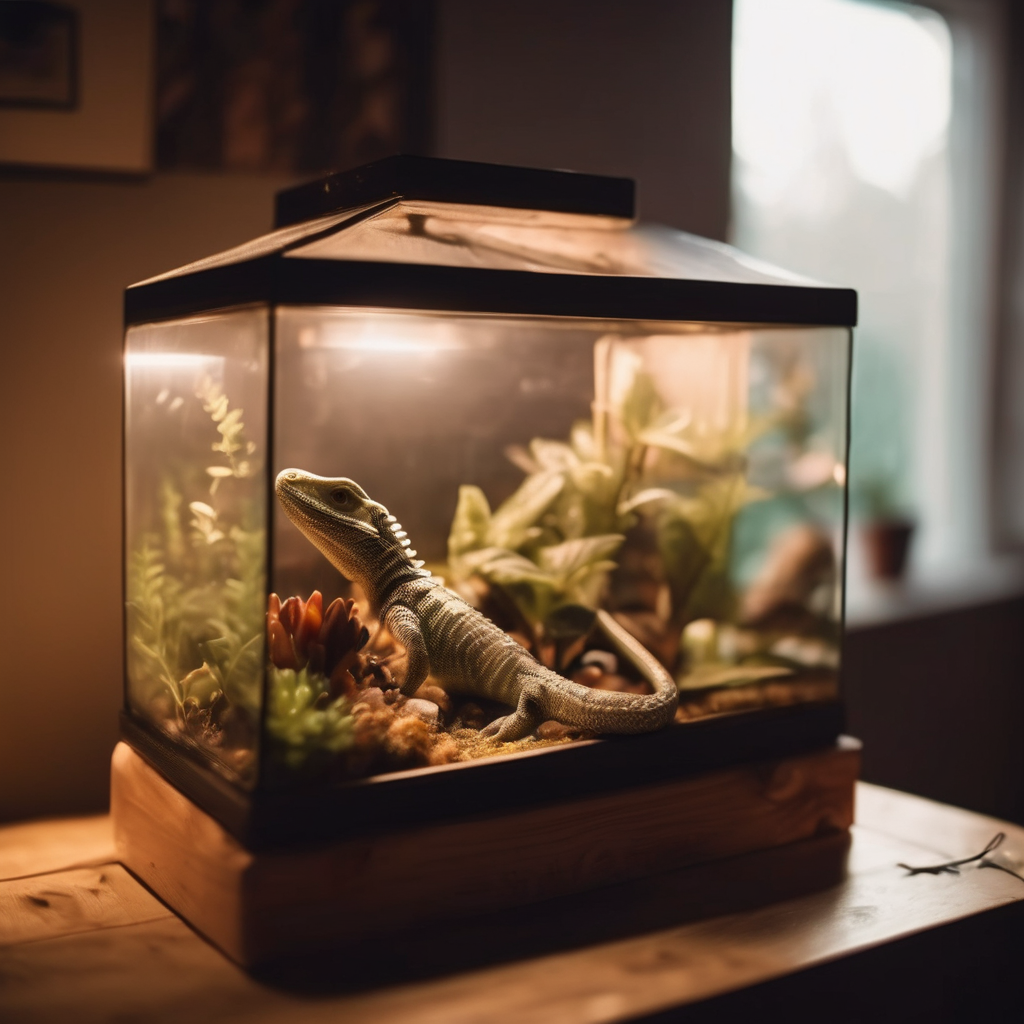
Most reptile setup advice covers heat, UVB, humidity and substrate, and stops there. Almost none of it covers the single decision you make before any of that: which room, and which wall, the enclosure goes on. That choice is not cosmetic. A snake kept in a hallway that vibrates every time a door closes, or a leopard gecko in a room that drops to 15 °C overnight, will fail to thrive no matter how good the thermostat is. Placement is a husbandry variable.
This guide covers the six constraints that should decide where your enclosure goes — light, drafts, noise, traffic, room temperature and electrical safety — plus the practical realities of weight, water access and cable management. It applies to a 20-litre gecko tub and a 1.8-metre python rack alike.
Why placement matters more than most keepers assume
A terrarium is not a sealed box. It is a semi-open system exchanging heat, moisture and air with the room around it. A glass enclosure has a large surface area, so it gains and loses energy quickly: that is exactly why you needed a thermostat in the first place. The same surface area means the room can dominate your climate control.
Three failure modes come from placement alone:
- Overheating. Sunlight through a window raises tank temperature far above what your thermostat controls. A radiant heat panel measures air temperature, not the glass surface, so it cannot compensate for direct solar gain.
- Chilling. A tank in an unheated room next to an exterior wall can drop 6–8 °C overnight, wiping out your warm side exactly when the animal is resting.
- Chronic stress. Reptiles read vibration, shadows and vibration-through-the-floor as predator cues. Constant footfall past the glass keeps a snake or gecko in a defensive state for months at a time.
None of these show up as an obvious emergency. They show up as a snake that feeds reluctantly, a gecko that hides constantly, a female that never cycles properly, or a slow unexplained weight loss that a vet finally traces back to your husbandry.
1. Light: never in direct sun, even for an hour
Direct sunlight on a glass or mesh enclosure is the fastest way to cook an animal. A single south-facing window can push an otherwise stable 30 °C basking spot past 45 °C within an hour on a bright day, and the animal cannot escape because the whole tank is lit.
Rules that hold up:
- No windowsill placement, ever, in any season, for any species.
- Indirect natural daylight is fine and useful — it helps your animal’s day/night cycle and lets you judge colour and condition honestly.
- If the only good spot has a window, block it with a curtain, a blind, or frosted film, and keep the curtain closed during peak sun.
- Watch the seasonal path of the sun. A corner that is shaded in December can be blazing in June.
Direct sun also ruins the plant side of a bioactive setup and drives algae across the glass. For the lighting your animal does need, our guide on UVB lighting for reptiles covers bulbs and distances, and the photoperiod guide explains how to time them.
2. Room temperature stability
Your heat source can raise air temperature above ambient, but it cannot reliably fight a cold room overnight. Heat mats and ceramic bulbs sized for a 22 °C room will struggle in a 14 °C bedroom in January, and every degree of night-time drop costs you in digestion and immune function.
Practical targets:
| Room type | Verdict | Notes |
|---|---|---|
| Heated living room, interior wall | Ideal | Stable 20–23 °C, easy to monitor |
| Heated bedroom | Good | Check night-time temperature with a probe before committing |
| Conservatory / sunroom | Poor | Wild swings: 12 °C at dawn, 40 °C at noon |
| Garage, shed, attic, cellar | Only for cold-tolerant species, never for tropicals | Needs insulation, humidity control and frost protection |
| Hallway or landing | Workable but noisy | Usually cold at night; check with a thermometer, do not assume |
Before you buy anything, tape a cheap digital thermometer at the intended spot and log minimum and maximum for a full week. That data beats any assumption about how warm a room feels to you. Once the enclosure is running, your gradient matters more than a single average: see how to set up a hot side and cool side.
3. Drafts and airflow
Reptiles are cold-blooded, but they are not helped by moving air. A draft pulls moisture out of the substrate, dries out shed in progress, and can drop the cool-side temperature several degrees while your air probe reads fine in the middle of the tank.
Avoid:
- Directly in front of a radiator, air-conditioning vent or fan heater.
- Underneath an open window, or on a wall with an exterior door.
- Immediately beside a door that opens to outside air.
- Dead corners with no air movement at all, which trap humidity and grow mould on the walls of the tank.
The fix for an unavoidably draughty room is usually physical: a solid-sided enclosure instead of mesh, a glass or acrylic lid instead of screen, and a more aggressive misting schedule. Our humidity control guide goes into detail.
4. Noise and vibration
This is the most underrated factor. Snakes and geckos detect vibration through the substrate and the floor far better than they hear airborne sound. A television, a washing machine on spin, a door slamming, a barking dog or children running past are all chronic stressors when they happen next to the glass.
Placement rules:
- Never against a wall shared with a bathroom that has a washing machine on the other side.
- Keep out of the main walking route between two rooms.
- Do not site an enclosure directly beneath a floor that is upstairs of the room.
- A quiet corner beats a prominent display position. Your animal is not an ornament.
- If the only option is a busy spot, raise the enclosure on a rubber mat or dense foam pad to damp floor vibration.
Stress symptoms from placement overlap with illness, which is why knowing the warning signs matters before you start troubleshooting equipment.
5. Traffic, children and other pets
An enclosure in a thoroughfare gets tapped, opened and poked. Every lid lift is a chance for an escape, and every tap on glass is a stress event. Three separate risks compound:
- Escapes. A snake in a hallway will find a gap within months. Terrestrial snakes and arboreal species in mesh-topped tanks are the usual escapees.
- Thermal shock. An open lid in a 20 °C room drops humidity in minutes and cools the basking zone.
- Zoonoses and bites. Handling areas shared with children mean shared hand-washing rules. Read our safe handling guide before you let anyone else open the tank.
Choose a spot you can lock or at least close a door on. For a bedroom, that is usually the corner furthest from the doorway.
6. Electrical safety
Reptile rooms combine heat sources and water. That combination has killed people. Treat it seriously:
- No power strips on the floor, none under a misting system, none inside a cabinet where a leak can reach them.
- Use a drip loop on every cable: run the cable below the socket before it goes up, so water running down the cord drips off rather than into the plug.
- Give each heat source its own thermostat-controlled circuit where possible, and never rely on the bulb’s built-in dimmer for a high-wattage ceramic.
- Use an RCD/GFCI-protected socket in any room with water features.
- Ceramic bulbs, heat lamps and radiant panels get hot enough to ignite wood. Keep the specified clearance from the lid and from anything flammable.
Wiring, timers and safe multi-device setups are covered in our terrarium automation guide, and the thermostat guide explains why every heat device needs one.
Weight, size and water access
Two practical constraints stop most plans before biology does.
Weight
A filled glass terrarium is heavier than people expect. Use this rough arithmetic:
- Water weighs 1 kg per litre. A 200-litre paludarium with a 100-litre water section weighs about 100 kg of water alone, plus glass, substrate and rock.
- Dry substrate runs 15–25 kg per 50 litre of tank volume; a bioactive layer with drainage balls and soil is heavier still.
- Rock and slate decor adds up fast. Ten kilos of rock is common in a bearded dragon setup.
Use furniture rated for the load, spread the weight over the whole footprint, and never put a large enclosure on a shelf unit that was designed for books. Upstairs rooms with old floorboards need a weight check. If you are building a rack, substrate and layer depth changes the maths considerably.
Water access
You will change water and carry buckets. A paludarium or aquatic setup placed away from a sink or drain becomes a weekly chore you resent. Choose a room with a floor you can mop and a tap within a few metres. For step-by-step water work, see the reptile tank cleaning schedule.
Physical clearance
Check door widths, ceiling height, corners and the path from the car. Large front-opening terrariums are designed to be serviced in place, which is worth the extra cost if the route is tight. For aquatic and semi-aquatic builds, the paludarium guide covers drainage plumbing, which needs a location with somewhere for water to go.
Where placement goes wrong by species
Snakes
Snakes need security more than light. A solid-sided tub or enclosure against a quiet wall, partly covered, out of the walking route, beats a beautiful glass display in the middle of the room. Ball pythons in particular do better in a low-traffic corner than in a showcase position.
Leopard geckos and other terrestrial lizards
Floor-level placement puts them at eye height for toddlers and dogs, which is a handling risk. Put them on a stable stand at waist height, off the floor, away from the walking route. Do not site them on the floor where a hoover or a cat can reach them.
Arboreal species
Chameleons and some frogs want height and visual privacy. A tall enclosure in a corner with a partial screen on one or two sides gives the vertical space and the sense of cover they need. Avoid siting a tall arboreal enclosure where people lean over it constantly.
Aquatic and semi-aquatic animals
Axolotls and aquatic amphibians need cool, stable room temperatures and a shaded, quiet room — a bright living room is actively wrong for an axolotl. Prioritise temperature stability and darkness over aesthetics.
A placement checklist you can run before buying
- No direct sunlight at any time of year on that spot.
- Logged minimum room temperature at that spot stays above 18 °C overnight, every night.
- No door, window, vent or fan blowing on the enclosure.
- Not on the walking route between two doors.
- No washing machine, dishwasher or plumbing on the other side of the wall.
- Children and other pets cannot reach it, and the door to the room can be closed.
- An RCD-protected socket within cable reach, with a drip loop and no floor-level strip.
- The stand or cabinet is rated for the filled weight, on a floor that will take it.
- A tap and a drainable floor within a few metres for water changes.
- The enclosure physically fits through the door and into position without dismantling the room.
Warning signs that your placement is the problem
If these appear, suspect the location before you blame the equipment:
- Chronic hiding. An animal that never leaves its hide during its active phase, in an otherwise correct setup.
- Persistent refusal to feed that does not respond to temperature, prey size or routine changes. Our refused feeds guide walks through the husbandry variables in order, and placement is the first one.
- Weight loss without obvious cause. Check night-time temperatures with a logging thermometer at the cool side, at substrate level, for a week.
- Repeated stuck sheds, especially on toes and tail tip — usually humidity or a draught, not nutrition. See shedding problems.
- Defensive behaviour: hissing, striking at the glass, tail rattling, or a gecko that drops its tail at every approach.
When to see a vet. Placement cannot explain everything. Book an exotic vet if you see open-mouth breathing, bubbles or mucus from the nose or mouth, a swelling or lump, blood in the mouth or vent, a sudden refusal to eat lasting more than three weeks with visible weight loss, twitching, tremors, seizures, a prolapse, or an animal lying flat with its head raised. Those are medical problems and a better room will not fix them. A pre-emptive visit to review your whole setup is worth it if you are unsure — bring photos of the enclosure, your thermometer readings and a feeding log.
FAQ
Can I keep a reptile tank in my bedroom?
Yes, provided the room is quiet, heated overnight and not draughty. Check the night-time temperature at substrate level for a week first — bedrooms are often the coldest room in a house after the heating drops. Keep the enclosure away from the bed and off the walking route.
Is a windowsill okay if I keep the blind closed?
It is a risk rather than a rule-out. Solar gain can still raise glass temperature on a bright day, and a blind that gets opened once in summer can cook an animal in under an hour. If you have another option, take it.
Can a snake live in a garage?
Only with real work. A garage needs insulation, controlled heating, humidity monitoring and frost protection, and it needs to be an interior insulated space rather than an uninsulated outbuilding. For tropical species, treat it as unsuitable without climate control. Temperate species handled by an experienced keeper can work — but log the minimum temperature through a full winter before you commit an animal.
How far should a tank be from a window?
Far enough that no direct beam ever lands on the glass in any season. Practically, that usually means not in the same wall section as the window, and definitely not in line with it. Test it with a bright day across the year if you can.
Does the noise of the TV bother my snake?
Airborne noise matters far less than vibration through the floor, but constant low-frequency thump and the shadows of people moving in front of the glass do cause chronic stress. A room where the television is on is fine; a room where people constantly walk past the enclosure is not.
My room has no good spot. What do I do?
Compensate physically. Use a solid-sided enclosure or a cabinet-style viv to reduce air exchange, add a thicker substrate to buffer temperature, upgrade to a radiant heat panel instead of a bulb for more stable output, and automate with a thermostat and timer so your control does not depend on the room. Start with our complete terrarium equipment guide and build from there.
The bottom line
Placement is free husbandry. A quiet interior wall in a heated room, out of the sun and off the walking route, with a properly rated stand and a protected socket, gives you a stable platform that every other piece of equipment can then work on. A showcase spot in a draughty, noisy, sunlit room fights you all year. Choose the boring corner, log your room temperature for a week before you buy, and spend the money you save on a good thermostat and a solid lid instead.
Leave a Reply