
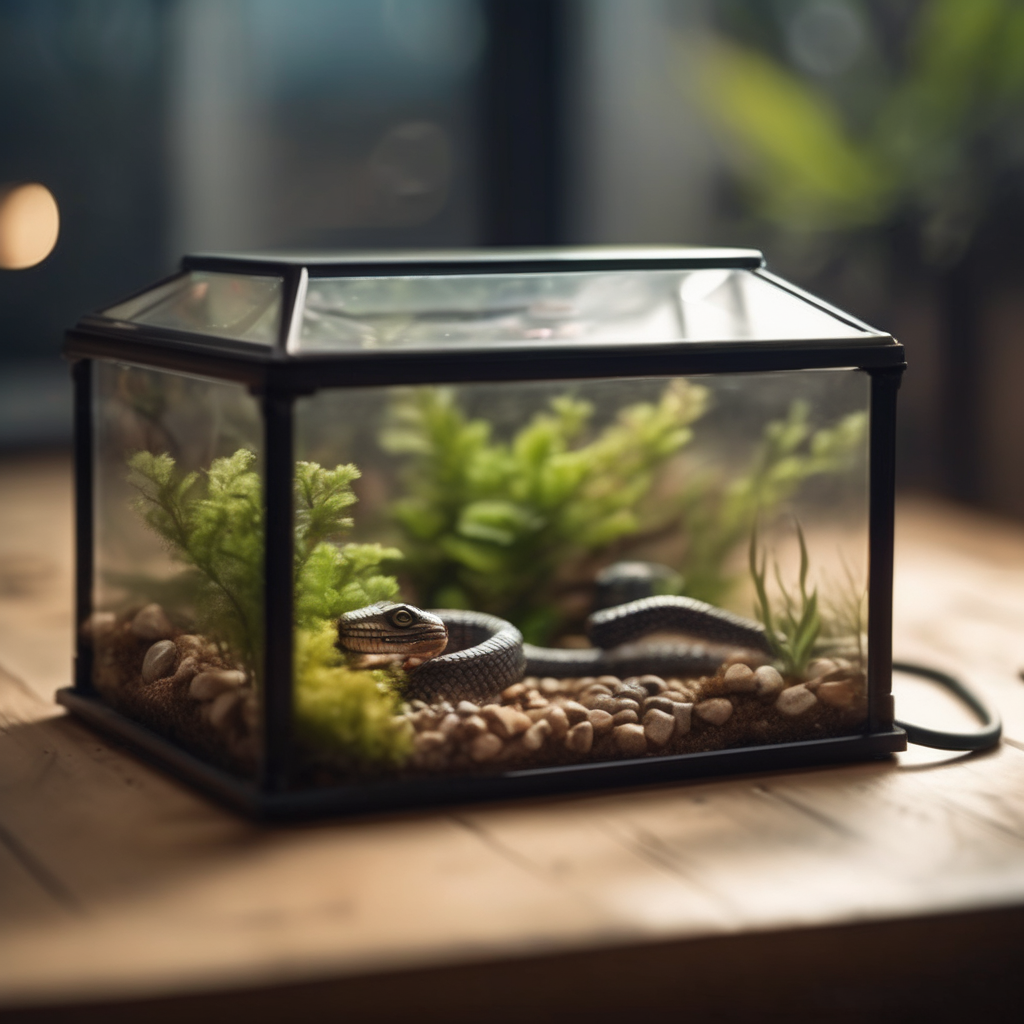
Every experienced keeper has a missing-animal story. A leopard gecko found behind a radiator three weeks later, thinner but alive. A corn snake loose in a kitchen for a fortnight, living on the warmth of the fridge compressor. A crested gecko that spent two days inside a sofa before a crumb of dropped food gave it away. None of these animals were in a badly built enclosure; they were in a well-built enclosure with one gap nobody measured, and reptiles are extraordinarily good at finding that one gap.
The physics is unforgiving. A reptile’s escape route does not have to fit its body, it only has to fit its skull, and in snakes the skull is made of separate bones that separate slightly under pressure. A gap that looks too small to matter, roughly the width of the animal’s head at its widest point, is a doorway. This guide is about auditing that gap systematically: where escapes actually happen, which lid hardware holds, how to seal cable and heater penetrations, and the first-hour recovery plan for when prevention fails. For the rest of the enclosure build, our reptile terrarium equipment guide and the snake enclosure setup guide cover size, heating, and humidity.
Where reptiles actually escape from
Escape reports cluster in a handful of places, and almost none of them are the obvious open top.
- The lid seam, not the lid. A glass terrarium is four panes; the lid sits on top of a rim that is a few millimetres wide. Push one corner down and the opposite corner lifts. One corner lifted two millimetres is enough for a juvenile gecko or a hatchling snake.
- Sliding glass front doors. Standard front-opening tanks have two panes that overlap. The overlap is the weak point, and the panes are held by the lid above and the floor trim below. A determined snake wedges into the overlap and walks out sideways.
- Cable and tubing holes. Heat mats, thermostat probes, misting lines, and UVB fixtures all need a cable out of the enclosure. The gap left around that cable is the most common escape route of all, and it is usually a clean round hole with a cable through it, which is geometrically perfect for a small lizard.
- Behind the backdrop. Cork bark and foam backgrounds rarely seal to the tank walls, and the void behind them is warm, dark, and full of climbing structure. Many escapes go into the enclosure’s own wall cavity and stay there.
- The heater guard or dome rim. Ceramic heat emitters and deep heat projectors sit on a mesh lid, and the wire cage rim under a bulb guard is often wider than the animal’s head. Snakes push up through the mesh constantly.
- Under the door of the room itself. Once an animal is out of the tank, it is often out of the room. A gecko under a closed bedroom door is now a whole-apartment search.
Step one: measure, do not eyeball
Buy a set of feeler gauges or just use a stack of coins and paper. The rule is simple and non-negotiable: every gap must be smaller than the width of your animal’s head, measured at the widest point, which for a snake is the jaw hinge and for a lizard is the temporal region behind the eyes.
The audit walkthrough
- Lights off, hands on. Sit in a dim room with a torch at a low angle and run a finger around every lid seam. Look for light coming through from the other side. Any visible line of light is a candidate gap.
- Lift each corner. Press down firmly on one corner of the lid and watch the diagonally opposite corner. If it rises at all, you have a lid that can be levered open. This is the single most common cause of escapes in tanks with clip-on hoods.
- Test the front sliding panes. Push each pane inward from outside, then try to slide it sideways against resistance. If it moves laterally at all, the overlap is not secure.
- Check every penetration. Count the cables and tubes leaving the enclosure, then look at each hole from inside the tank. If you can see daylight around a cable, seal it.
- Probe the backdrop. Press along the edges of the cork or foam background. Any gap wide enough for a fingernail is wide enough for a hatchling.
- Check the mesh itself. Stand back and look at the lid mesh. If a mesh opening is wider than your animal’s head, the mesh is a lid with holes, not a lid. This is the classic failure with tall arboreal tanks for growing juveniles.
- Check the drain or ventilation slots on aquatic and paludarium tanks; water-level gaps at the top of the glass are escape routes for anything that climbs.
Lid hardware that actually holds
Not all lids are equal, and the difference is usually not the lid but what fastens it.
Ranked by security
- Hinged lid with a padlockable hasp. The most secure standard option. A lid hinged at the back and locked at the front cannot be levered at all, because there is no free corner. Use two hasps on tanks over 120 cm long.
- Front-opening with a mechanical lock plus a weight on top. Purpose-built reptile cabinets with keyed or sliding locks are secure, but add a heavy object such as a stack of books on the top glass for juvenile snakes, which are the strongest escape artists of the common pets.
- Mesh lid with multiple spring clips, two per short side minimum. The standard glass-fish-tank lid with two clips at the front only will lever open at the back. Clips on all four sides, or at minimum on both long sides, are the practical fix.
- Mesh lid with clips plus a weight. Cheap, effective, and reversible. A brick or a paving slab on top of the lid defeats nearly everything except a snake strong enough to lift it, which for small species is nothing.
- Velcro or magnetic strips. Fine for a crested gecko in a secure room, not fine for a snake or a fast lizard. Treat them as supplementary only.
What does not work
- A single clip at the front. This is the default shipped with most glass tanks and it is the reason so many animals escape.
- Books stacked directly on the mesh without a rigid spreader. The lid bows between two stacks and lifts in the middle.
- Tape as a permanent solution. Tape adhesive fails with heat and humidity within weeks, and a lid held by tape is a lid that will fail on a day you are not there.
- Assuming the animal is too big. Ball pythons are legendary for escaping through gaps that appear absurdly small, and hognose snakes will push at a seam for hours.
Sealing cables and holes
Every cable leaving an enclosure needs a sealed penetration. The cleanest solutions, in order of preference:
- Route cables down and out through a purpose-cut notch at the back-bottom corner, then close it with a non-toxic sealant or a block of closed-cell foam. Exits at the bottom corners are far harder to reach than exits on the top.
- Use a rubber grommet sized to the cable. Drill a hole one size larger than the cable, insert a grommet, and pass the cable through it. The grommet compresses and closes the annular gap. This is the professional answer and it takes ten minutes.
- Use a cord protector with an adjustable gasket, the kind made for desk cable management, fixed inside the tank with aquarium-safe silicone.
- Stuff the gap with clean, undyed polyester fibrefill or a cut piece of closed-cell foam, then cover it with a small cork tile. Crude, but it works and it is easy to inspect.
Whatever you use, it must be non-toxic and heat-tolerant, must not create a new climbable surface, and must be inspectable without dismantling the tank. Never seal a penetration with duct tape on the inside, where an animal can chew or scratch it loose and ingest it.
Species-specific risks
Different animals fail enclosures in different ways, and knowing which one you keep changes what you fix first.
- Leopard geckos and other ground geckos: fast, flat, and surprisingly strong for their size. Lid corner lifts and cable holes are their routes. They also hide rather than flee, so a lost gecko is usually within a metre or two of the tank.
- Crested geckos: jumpers and clingers. They can climb smooth glass with their toe pads and will launch themselves at a gap. They also tolerate cool, dry rooms for longer than most reptiles, which makes them hard to find.
- Snakes: the strongest and most persistent. Ball pythons, corns, and hognoses push at a seam for hours. Juvenile snakes escape through gaps that seem impossible, and they are the reason front-opening tanks need a weight on the glass.
- Bearded dragons: climbers and diggers. Check that decor does not stack into a staircase under the lid, and that substrate depth does not allow burrowing up against a glass seam.
- Chameleons and other arboreal species: mesh lids are their standard enclosure, and mesh opening size relative to a juvenile’s head is the key check. They also fall rather than escape, so the risk is more often an open door during maintenance.
- Tarantulas and scorpions: a small gap between the lid and the tank wall is enough. Terrestrial tarantulas push substrate against the seam and then push through the resulting depression. Our tarantula safety guide covers the extra considerations for venomous species.
- Small mammals: hamsters, gerbils, and mice chew through plastic lids entirely. For those species the lid must be metal mesh, not vented plastic.
Room-level prevention
Tank security is the first line, but the room is the second, and it is the one people skip.
- Keep the terrarium room door closed. This alone converts a whole-house search into a single-room search.
- Block the under-door gap with a draught excluder or a rolled towel during any maintenance.
- Never open the tank on a surface with a drop to the floor, and never open it while another pet is in the room. A curious dog or cat turns an escape into a fatality.
- Do maintenance with a second closed container ready. Move the animal into a secure tub, not onto your hand or the desk.
- Keep the room free of accessible warm hiding voids. Behind a fridge, inside a boiler housing, under a radiator, inside a duct. If you cannot see into it, your escaped animal can.
- Cover floor vents and gaps under skirting in the terrarium room, since a small lizard will go straight into a wall cavity.
- Tell everyone in the house where the escape-risk gaps are. Most escapes happen during a cleaning session done by someone who did not build the setup.
The first hour: what to do the moment you notice
This is the part that decides the outcome. Most escapes are recovered, and the ones that are not usually share a cause: the keeper searched immediately, loudly, and widely, which drove the animal deeper.
Minute 0 to 10: secure the room
- Close the door. Do this before anything else.
- Get other pets out of the room and shut them elsewhere.
- Check the tank itself first, including under the substrate, inside hides, behind the backdrop, and inside any decor. A large fraction of “escapes” are animals that never left.
- Look at the floor within one metre of the tank. Most reptiles do not travel far in the first minutes; they bolt to the nearest dark, warm, tight space.
Minute 10 to 30: the low-disturbance sweep
- Lights low, phone torch angled along the floor. Look for eyeshine and for movement, not for the animal’s pattern.
- Work the room perimeter, then behind and under furniture, along warm routes: radiators, pipes, the back of a fridge, the boiler housing, under the bed.
- Do not move furniture yet. Note candidate hiding places first, then look inside them one at a time with the torch, from a distance if possible.
- Set up a warm, secure trap area. A plastic tub with air holes, a shallow water dish, and a heat mat on one side set to the animal’s preferred warm temperature, placed against a wall in a quiet corner of the room. Cover the tub with a dark cloth so it reads as a safe hide.
- Reduce competing hazards. Turn off sticky traps. Move any toxic plants or chemicals out of the room. Cover open buckets and toilet lids.
Hour 1 to 24: the food and humidity approach
- Leave the trap and check it every few hours, quietly, with a torch rather than by lifting the tub.
- For insectivores, offer a few live insects near the trap or in the corner where you last saw movement. A hungry gecko will often come out for food it can see.
- Lower the room’s competing heat sources if safe, so your trap is the warmest option, but never make a room dangerously cold.
- Try a flour trail. A thin line of flour along a wall edge will show footprints and tell you the direction of travel. This is old, crude, and genuinely effective.
- Check the same routes at the same time of day. Many escapes happen at night; a sweep at 2 a.m. finds more than a sweep at midday.
After 24 hours
- Expand systematically, one room at a time, closing each door behind you and searching low, dark, warm spaces before open floor.
- Search vertically as well as horizontally. Escaped snakes climb curtain rails and shelving; geckos climb walls and sit behind picture frames.
- Check appliances from outside. Look under and behind the fridge and washing machine with a torch and a mirror before ever moving them. A snake inside a washing machine drum is a real and recurring scenario.
- Ask neighbours if you live in a shared building and check communal corridors and stairwells.
- Post on local lost-pet and reptile groups. Escaped reptiles are frequently found by a neighbour days later.
When you find it
Do not grab. Contain first: cover the animal with a towel or guide it into a tub, then move the tub. Check for injuries, especially a damaged nose or rostrum from pushing at seams, and look for scale rot or dehydration signs in snakes. Quarantine behaviour matters here too; an animal that has been behind a radiator for three weeks has been exposed to dust, cleaning chemicals, and unknown temperatures. Follow the first-30-days approach of observation before normal feeding resumes, and see a vet if the animal is thin, has mouth damage, or has not eaten within a week of recovery.
Warning signs your setup is one bad night from an escape
These are the inspections that catch the problem before it becomes a search:
- You find shed skin outside the tank. A snake that sheds loose has been out, even if you cannot see where.
- Substrate is banked against one seam or a corner is pushed down; something has been working at that spot.
- A nose rub or scuffed scales on the rostral area, which is the signature of a snake pushing at a gap.
- Decor stacked into a staircase that reaches the lid height.
- You routinely open the lid with one hand and it lifts more than it should; that is a levered lid, and an animal can lever it too.
- Cable holes you have stopped noticing. If you cannot remember when you last looked at them, look now.
- A recently grown juvenile. A tank that was escape-proof for a hatchling is not escape-proof for a three-month-old, because the animal’s head is now wider than the gap you originally accepted.
When to involve a vet after an escape
Not every recovery needs a vet visit, but these do:
- Any visible wound, especially to the mouth, nose, or tail tip.
- Weight loss you can see, or a visibly sunken tail base and hips in a gecko.
- Lethargy, gaping, or abnormal posture after recovery.
- Suspected exposure to a toxin: cleaning products, pest bait, human medication, or a treated houseplant. Call immediately and take the product with you.
- Not eating within seven to ten days of recovery, or regurgitation on first feeding.
- Suspected thermal injury from time inside an appliance or against a boiler.
Frequently asked questions
How long can a lost reptile survive? Weeks to months, depending on species, temperature, and humidity. Geckos in a warm house have survived three to four months. Snakes slower and longer. The limiting factor is almost always dehydration or an untreated injury, not starvation.
Can a ball python really get through a gap that small? Yes. Their skull bones are only loosely connected and they routinely flatten through gaps that look impossible. If the gap is wider than the head, assume it is a door.
Should I leave the tank open so it can come back? No. Keep the tank secure and put the trap on the floor beside it. An open tank teaches nothing and risks a second escape during the search.
Will my reptile come out for food? Insectivorous lizards often will, especially at their normal feeding time. Snakes usually will not until they feel safe, and pushing food at a hiding snake mostly stresses it.
Is a lockable cabinet worth the cost? If you keep snakes, arboreal species, or multiple reptiles, yes. It removes the levered-corner failure mode entirely and it looks better than a brick on a mesh lid.
My gecko escaped from a tank I was sure was secure. What did I miss? Almost always a cable hole or a backdrop gap. Both are in the audit list above and both take five minutes to fix.
Checklist: the fifteen-minute escape audit
- Measure your animal’s head width and write it down. That number is now your maximum permitted gap.
- Press each lid corner in turn and watch the opposite corner lift. Fix any lift with clips on all four sides or a weight.
- Count every cable and tube leaving the enclosure and seal each hole with a grommet or foam.
- Press along the backdrop edges and seal any fingernail-wide gap.
- Check mesh opening size against head width, not against body width.
- Remove any decor staircase that reaches the lid.
- Confirm the terrarium room door closes and block the under-door gap.
- Keep one secure plastic tub permanently available for maintenance and emergencies.
- Re-run the audit whenever the animal grows or you change heating equipment.
The bottom line
Escape prevention is not about buying an expensive tank, it is about measuring gaps against a number you have actually written down and then closing every one of them. Clip all four lid corners, grommet every cable hole, seal the backdrop, keep the room door shut, and re-audit every time your animal grows. Do that and the probability of a missing pet drops close to zero. If it still happens, the plan above is the one that works: secure the room, search low and warm with a torch rather than by moving furniture, set a warm dark trap, and check it quietly every few hours. For the enclosure fundamentals that make all of this easier, start with our reptile terrarium equipment guide.
Leave a Reply