
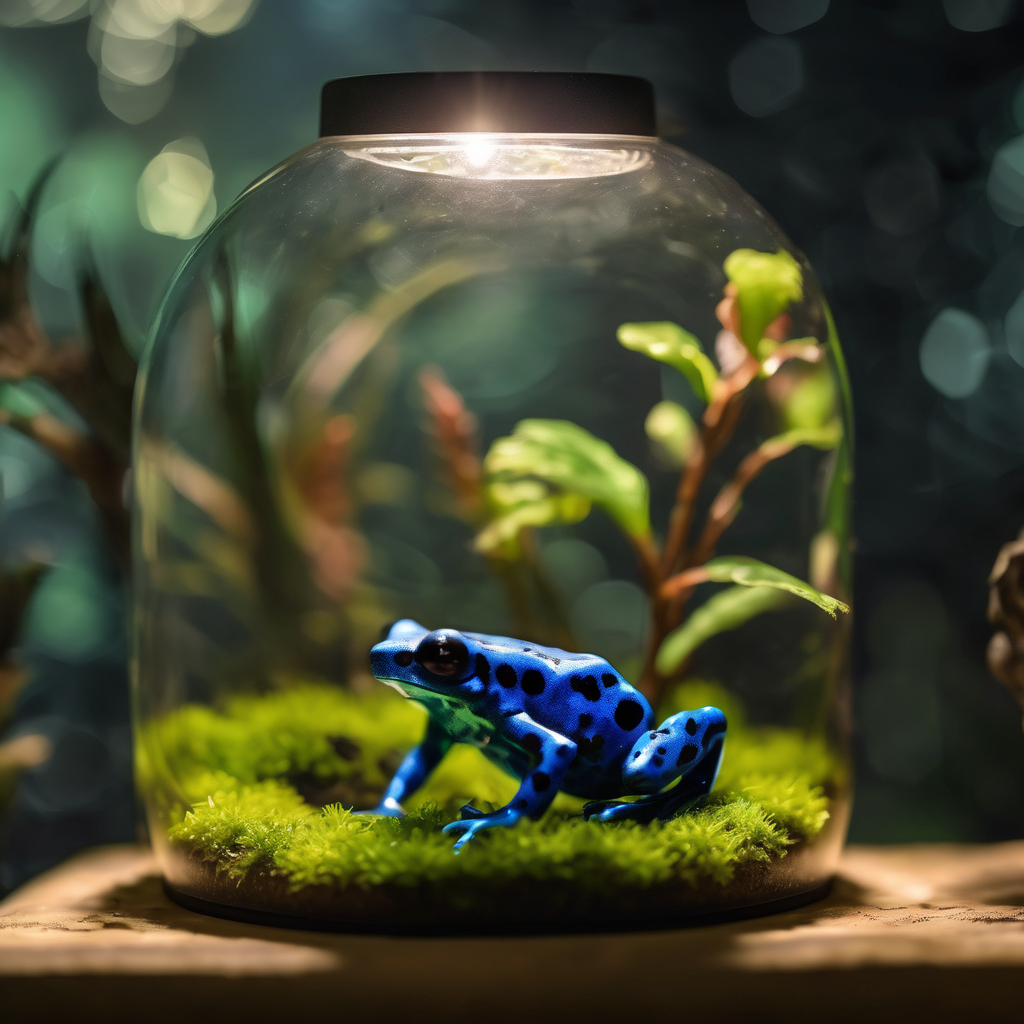
Lighting is where amphibian keepers waste the most money, and occasionally do the most harm. The pet trade sells every frog owner a heat bulb, a UVB bar and a “day and night” bulb, and most of that equipment is either useless or actively dangerous for the animal. A dart frog overheating under a ceramic heat emitter in a 45 × 45 cm planted tank is a genuine and common death. At the same time, a genuinely useful low-level UVB bulb is one of the cheapest insurance policies you can buy.
This guide separates the three jobs lighting does in an amphibian enclosure — UVB, heat, and plant growth — and explains which of them your species actually needs. It is part of the pet amphibians series, and it assumes you already have the right enclosure and humidity control working.
The three jobs of amphibian lighting
Keep these separate in your head, because they are separate purchases:
- UVB lets the animal synthesise vitamin D3, which lets it absorb calcium from food. Too little over months produces metabolic bone disease. Too much burns the skin. Amphibians need far less than reptiles — typically a 1-star (low output, shaded) UVB bulb.
- Heat raises air temperature. Most commonly kept frogs come from tropical forest floors where the air is 22–26 °C — which is close to ordinary room temperature in a heated house. A heat bulb in a small, humid, enclosed terrarium is a common cause of fatal overheating.
- Plant light grows the live plants. This is a horticultural concern, not an animal concern, and in a bioactive setup it is often the reason you need the most powerful lamp in the tank.
The mistake is buying one “amphibian kit” and assuming it does all three. It rarely does any of them well.
Do amphibians need UVB?
The honest answer is it depends on the species, and low-level UVB is beneficial for most of them. The old hobby advice — “nocturnal frogs don’t need UVB” — has not held up under testing. In the wild, even crepuscular and nocturnal species bask briefly at dawn and dusk, and a large body of keeper evidence now links low-level UVB with better calcium metabolism, stronger breeding behaviour and fewer deficiency problems.
Which species benefit most from UVB
- Diurnal and partially diurnal species: poison dart frogs (Dendrobates and Phyllobates), fire-bellied toads, many tree frogs. These are the clearest beneficiaries — provide UVB.
- Crested geckos and other nocturnal/crepuscular species: benefit from a low-output shaded bulb, not a bright 5-star one.
- Fully aquatic species (African clawed frogs, axolotls): UVB is absorbed by water, so it needs to be a submersible-rated aquarium UVB bulb mounted inside the tank, and intensity must be low. Axolotls in particular do poorly with bright light of any kind and prefer dim conditions.
- Strictly fossorial species (caecilians, some burrowing salamanders): never see light, so UVB is irrelevant — provide dietary D3 instead.
Choosing and placing a UVB bulb
- Buy a 1-star (2.0) shaded-output compact or T5/T8 tube designed for forest-floor species. The 10.0 high-output versions made for desert baskers will burn amphibian skin, which is far more delicate than reptilian skin.
- Place it at one end of the enclosure so the animal can move in and out of range, and make sure there is dense planting or a hide that blocks it. Amphibians self-regulate by moving away — give them somewhere to go.
- Never place UVB above glass without checking transmission. Standard glass blocks most UVB; a mesh lid does not. Distance matters more than anything: follow the manufacturer’s distance table, and if your tank is shorter than the recommended distance, use an even lower-output bulb rather than moving closer.
- Replace the bulb every 9–12 months. UVB output decays invisibly long before the visible light dims — a two-year-old UVB bulb is a decoration.
Dust or bulb?
Whether you use a UVB bulb or a calcium supplement with D3 is a genuine choice, not a requirement to do both. UVB plus D3-dusted food risks vitamin D3 toxicity, which causes organ calcification and is just as damaging as deficiency. The safe approach most keepers use: low-level UVB plus calcium without D3 on most feedings, with a D3-containing supplement only once or twice a week. Read the label on your powder and count your D3 from both sources.
Heat: why most frog tanks do not need a bulb
A tropical forest-floor frog wants 22–26 °C air and a small warm patch it can choose. A normal heated room already provides that. Adding a heat source to a small glass-topped terrarium solves a problem you probably do not have, and creates one you cannot see from outside: a hot spot of 35 °C in a fully enclosed box with 80% humidity. Amphibians breathe partly through their skin and cannot escape a hot spot in a small enclosure — the classic failure is a keeper finding a frog dead in the corner furthest from the bulb, cooked and dehydrated.
When you do need extra heat
- Your room regularly drops below 20 °C overnight or in winter. This is the most common legitimate reason.
- You keep a species with a higher requirement, such as a Mediterranean fire-bellied toad or an arid-adapted species.
When you do need it, choose in this order of safety:
- Heat mat on one side wall only, controlled by a thermostat with a probe, never left uncontrolled. It warms a hide rather than the whole air mass.
- Low-wattage ceramic heat emitter or deep heat projector in a dome with a guard, also on a thermostat, placed above the land area only and never above the water.
- Room heating. The boring answer. If the room is 24 °C, the tank is 24 °C and nothing in the enclosure can fail.
Whatever you use, put a digital probe thermometer in the tank and read it daily. The absolute ceiling for most commonly kept amphibians is 29 °C air temperature; sustained readings above that are an emergency, not a preference.
Light bulbs are not heat sources
Do not run a bright basking bulb to “keep the tank warm”. Amphibians hide from intense light, which means a light-based heat source drives the animal away from the only warm spot available. If heat is needed, heat it with something that does not emit visible light, or with a low-wattage mat.
Plant lights: the reason your moss keeps dying
In a bioactive terrarium, the plants are part of the life-support system: they consume waste, transpire humidity, and provide cover. Most “planted terrarium fail” stories are lighting failures. Two rules govern this:
- Brightness is not what kills amphibians — heat is. A full-spectrum LED that produces very little heat can run bright enough to grow orchids without warming the tank at all. That is the ideal amphibian light.
- Pick a light by PAR, not by the picture on the box. Low-light plants (java fern, mosses, pothos, philodendron, most bromeliads) need roughly 30–80 PAR at leaf level; medium plants (many ferns, anthuriums) 80–150; high-light plants (most orchids, air plants, carpeting plants) 150–250+. A 20 cm-high terrarium needs a much weaker fixture than a 60 cm one, because intensity falls with the square of distance.
For most frog terrariums under 60 cm, a 10–25 W full-spectrum LED with a colour temperature around 5000–6500 K is the sweet spot: enough to keep moss and pothos alive, negligible heat. If your plants are etiolating (long, thin, reaching toward the light), add a second fixture or raise wattage modestly. If your frog is spending all day pressed into the darkest corner, your light is too bright — dim it or add more cover.
Photoperiod: how long the light stays on
Amphibians need a consistent day-night cycle to regulate feeding, activity, and in many species, breeding. A 12-hour photoperiod is the standard and safe default; a 10-hour cycle suits strongly nocturnal species and a 13–14-hour cycle suits diurnal dart frogs and fire-bellied toads. Two things matter more than the exact number:
- Consistency. Put it on a cheap plug-in timer. A cycle that drifts by an hour a day (because someone switches it off manually) causes chronic low-grade stress and suppresses appetite.
- A real night. Amphibians do not need a blue “moonlight” bulb, and most of them are disturbed by one. Darkness is fine and normal. If you want to observe them at night, use a red bulb briefly.
The UVB and the plant light can share the same timer if both are appropriate for your species. Do not leave UVB running 24 hours a day — D3 synthesis follows the light cycle, and continuous exposure risks overdose.
Seasonal adjustment: a modest shift of 1–2 hours per day between summer and winter helps trigger natural behaviour, and is central to the approach in the amphibian winter care guide for species that need it.
Warning signs your lighting is wrong
- The frog is always in the darkest corner during the day — the light is too bright, or there is no shaded retreat. Add cover before dimming.
- Red, inflamed or patchy skin — UVB burn. Remove the UVB immediately, reduce output, and give the animal a shaded hide it cannot be seen from above.
- Jaw deformities, rubbery limbs, tremors or a “sprawling” posture — metabolic bone disease from inadequate D3/calcium, covered in the MBD guide. Book a vet visit rather than experimenting.
- Plants etiolating or algae covering everything — the light spectrum and duration are wrong for the plants. This is a horticulture problem, but it also degrades the humidity system the frog depends on.
- Air temperature above 29 °C — remove the heat source now. Overheating in a small humid enclosure kills within hours and looks like “found dead in the corner”.
- Refusing food with a healthy-looking enclosure — check the day/night timer is actually cycling, and check whether the photoperiod has drifted.
Anything on this list that persists after you have corrected the lighting needs a professional read: see amphibian warning signs and vet visits, and be aware that a vet trip for an amphibian has its own preparation rules.
Common lighting mistakes
- Using a high-output desert UVB bulb. Made for bearded dragons, fatal to dart frogs.
- A ceramic heat emitter in a small terrarium with no thermostat. The single most common way new keepers cook a frog.
- Running a bright plant light with no shaded cover. The frog hides constantly, eats less, and slowly declines.
- Leaving UVB on 24/7 or running a bulb past its 12-month replacement date.
- Doubling up D3 — UVB plus D3-dusted food every feeding — which causes toxicity.
- No timer. A manual light cycle is a drifting light cycle.
- Choosing a light by the box art instead of by PAR and wattage. Most “terrarium lights” sold for small tanks are grossly underpowered for live plants and the moss dies in six weeks.
Setup checklist by species group
- Poison dart frogs and other diurnal small frogs: 12–13 hour cycle, 1-star UVB at one end, low-wattage full-spectrum LED for plants, no heat bulb unless the room drops below 20 °C.
- Fire-bellied toads (semi-aquatic): same, plus a land basking area the lamp warms slightly; no bright overhead spotlight.
- Crested geckos: 10–12 hour cycle, shaded low UVB, cool-to-warm gradient 22–26 °C, plant LED for the enclosure.
- Newts (including fire-bellied newts): 10–12 hour cycle, low UVB optional but beneficial, water temperature driven by room temperature, aquatic plants lit by the same fixture.
- Axolotls and aquatic frogs: dim light, no overhead heat source at all, submersible UVB only if used at all, temperature controlled by the room or an aquarium chiller/heater.
- Salamanders: dim, shaded light; the priority is a cool, moist retreat. See the salamander care guide for species-specific temperatures.
Frequently asked questions
My frog is nocturnal — can I skip UVB entirely?
You can, and many keepers do, provided you use a calcium supplement containing D3 on a regular schedule. But low-level shaded UVB is the more reliable route for most species, because it lets the animal regulate D3 itself. If you skip the bulb, be disciplined about the supplement; if you fit the bulb, switch to a calcium powder without D3 for most feedings.
Do I need a night bulb or moonlight bulb?
No. Darkness is correct. Moonlight bulbs exist to let you watch your animals, not to serve them, and a permanent blue glow at night disturbs the cycle the timer is there to protect. If you want night viewing, use a red bulb for a few minutes.
How do I know if my plant light is bright enough?
Look at your plants. Healthy moss is dense and bright green; etiolated growth is thin, pale and reaching. If moss only grows on the side facing the light, add a second fixture. If algae is spreading over the glass and the plants are fine, the light is on too long — reduce to 10 hours.
Can I use a reptile heat bulb for a frog tank?
Only if the tank is large, the bulb is on a thermostat with a probe, and the animal has a genuinely cool retreat at the far end. In the small glass-topped terrariums most frogs live in, the answer is no — use room heating or a mat on one wall instead.
How often does the UVB bulb need replacing?
Every 9–12 months for compact and T8 bulbs, and per the manufacturer’s schedule for T5 tubes — usually 12 months. Mark the replacement date on the fixture with tape. Visible brightness is not an indicator of UVB output.
Is LED or fluorescent better for a planted frog terrarium?
LED, in almost every case. Modern full-spectrum LEDs produce the PAR the plants need with a fraction of the heat of fluorescent or metal halide, and heat is the dangerous variable in amphibian enclosures. Fluorescent T5HO tubes are a reasonable budget option in taller tanks; avoid anything that gets hot to the touch above the mesh.
Will bright light hurt my frog even if it is cool?
Bright light itself is not lethal, but it removes the animal’s ability to behave naturally. A dart frog that cannot find shade will sit in the water dish, stress, and stop eating. Dense planting and a covered hide solve this far better than dimming the light below the level the plants need.
Bottom line: give most amphibians a shaded low-output UVB bulb, a 12-hour timer, a low-heat full-spectrum LED for the plants, and no heat source at all unless your room genuinely runs cold. Verify everything with a digital probe thermometer rather than the number printed on the bulb’s box, and read the UVB fundamentals if you are unsure which output level your species needs.
Leave a Reply