
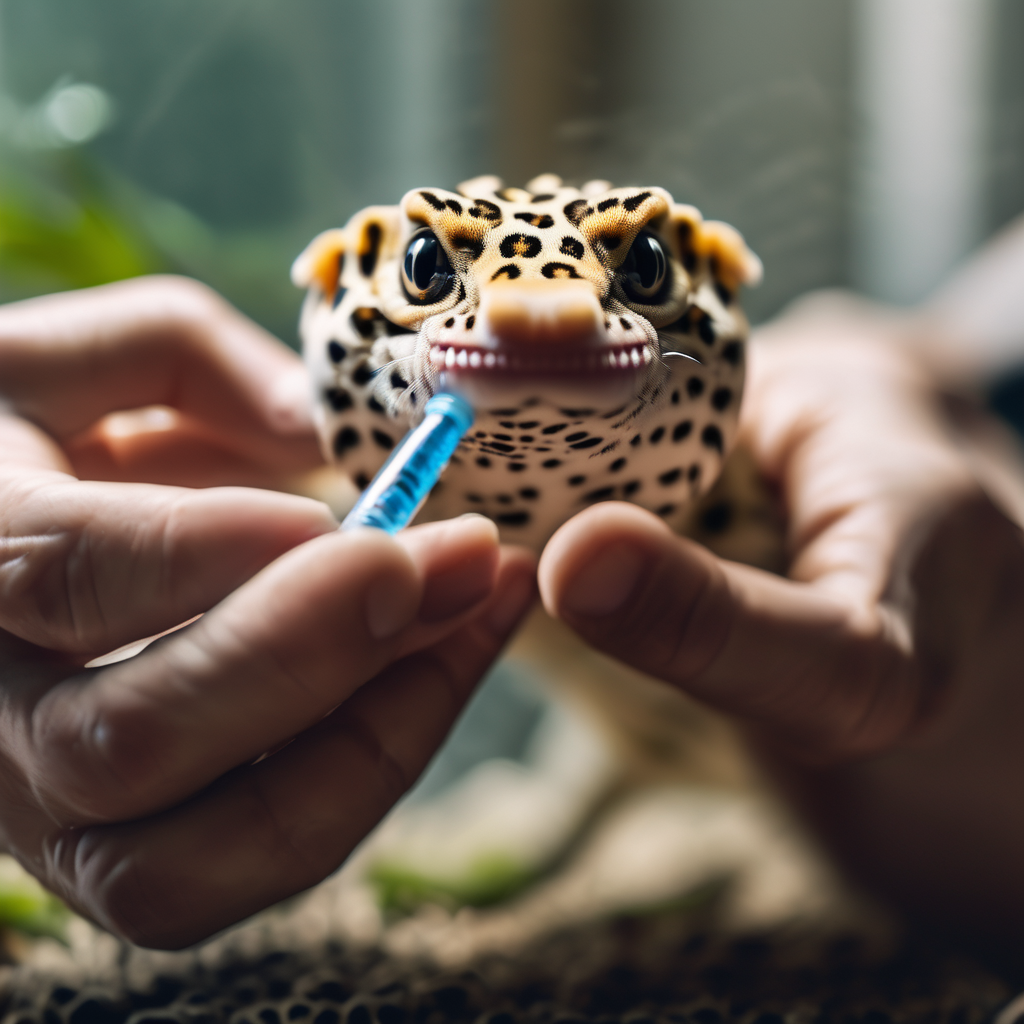
At some point in a reptile’s life, your vet will hand you a bottle of medication and a dosing schedule, and you will have to go home and actually give it. That is the part most care guides skip. They cover the diagnosis, the temperature gradient, and the humidity target, then trail off at “administer as directed” — as if a leopard gecko will cooperate. It will not. Reptiles are small, fast, mouth-open animals with a shared opening for air and food, and a dosing session done badly can end in aspiration, a dropped dose, or a stressed animal that refuses to be handled for a week.
This guide covers the four things keepers most often need to do at home: oral dosing without the liquid going down the wrong way, topical application where it will actually be absorbed, injections your vet has prescribed and trained you to give, and assist-feeding for an animal that has stopped eating. Read the whole guide before you start, because the technique that works for a 60-gram gecko is wrong for a three-kilogram boa, and the single most common home dosing mistake — squirting liquid into a reptile’s mouth — is the one that can kill it.
Before you dose: what your vet must give you
Never start a medication because a forum recommended it. Reptile metabolism is not mammal metabolism, and drugs that are routine in dogs are lethal in snakes. Before you leave the appointment, confirm you have five things in writing:
- The drug name and concentration — not just “the antibiotic”. Ask for the mg/mL strength so you can check your own dose calculation.
- The dose in mg per kg of body weight — this is the number that travels with the animal, not the millilitre amount.
- The route — oral, topical, subcutaneous, intramuscular, or nebulised. These are not interchangeable.
- The frequency and duration — including whether “twice daily” means every 12 hours or just twice in a day.
- What to do on a missed dose — double up, skip, or call. Get the answer before you need it.
Then weigh your animal. Not estimate — weigh it, in grams, on a kitchen scale with a container tare. A 20% weight error is a 20% dose error, and a 20% overdose of many reptile drugs is an overdose. Write the weight, the concentration, and the calculated volume in mg/kg on the same piece of paper as the schedule. Re-weigh every two weeks during a long course, because a growing juvenile’s dose changes.
If any of the five items above is missing, call the clinic back before you dose. A vet who has seen your animal is the only source of a correct prescription — the dosing table in a generic reptile book is a starting point for a vet, not a treatment plan for you.
Golden rules that apply to every route
- Never force liquid into a reptile’s open mouth. Their glottis — the airway opening — sits at the base of the tongue and stays open when the mouth is gaped. Liquid poured into a gaping mouth goes straight into the lungs. Aspiration pneumonia from home dosing is a genuine cause of death in reptiles, and it is entirely preventable.
- Dose at the same time of day. Reptile drug levels follow a rhythm; a dose at 8am, 4pm, and then 9pm the next day creates gaps where resistant bacteria regrow. Set an alarm.
- Finish the course. Stopping antibiotics on day four of a ten-day course because the animal looks better is how you breed a resistant infection. Finish, then recheck if your vet asked for a recheck.
- Do not store mixed doses. Suspensions that need shaking must be shaken every time — an unshaken bottle delivers mostly solvent on the first dose and mostly drug on the last.
- Use a fresh syringe each time and never reuse a needle. Needles dull on first use and cause real pain on second.
- Log every dose — date, time, drug, amount, initials. On day seven you will not remember whether this morning’s dose happened. A scribble on the fridge is a medical record.
Oral dosing: getting liquid in without aspiration
Oral dosing is the most requested route and the most botched. The safe technique is to place the liquid at the back corner of the mouth with the mouth mostly closed, slowly, so the animal swallows it rather than aspirates it.
The technique, step by step
- Draw the dose into a 1 mL syringe (no needle) and expel any air bubble. A bubble can be half your dose on a 0.1 mL volume.
- Restrain the animal gently but completely. For a lizard, one hand over the shoulders with the body supported, head between index finger and thumb — enough control that the head cannot whip, not enough to restrict breathing. For a snake, one handler supports the body while a second does the mouth. Never restrain alone if you are new to it.
- Open the mouth by pressing at the jaw line, not by pulling the head open. A reptile that resists will clamp down; a reptile whose mouth is already slightly open is easier.
- Insert the syringe tip into the back corner of the mouth — past the teeth, alongside the tongue, at roughly a 45° angle toward the throat. Not into the centre, not toward the tongue base. The centre is where the glottis sits.
- Depress the plunger slowly, over two to three seconds for a small animal. Fast delivery overwhelms the swallow reflex. Give more time for thicker suspensions.
- Hold the mouth closed and the animal upright — head slightly raised, not lowered — for 10 to 15 seconds while it swallows. Watch the throat for the swallow movement.
- Watch for liquid at the nostrils or mouth corners. Any liquid appearing at the nose means some went the wrong way. Stop, keep the animal head-down so anything in the airway drains forward, and call your vet.
Making a bitter drug go down
Many reptile antibiotics taste foul, and a dose spat back out is no dose. Options, in order of preference:
- Ask your vet for a flavoured formulation or a compounded version. This is the cleanest answer and often available.
- Mix with a tiny amount of a strongly-flavoured vehicle — a drop of fruit baby food, a pinch of banana, or a reptile-specific vitamin paste — but only if your vet confirms the drug is stable in food and the volume is small enough that your animal will take it all.
- Split the volume and increase the frequency with your vet’s approval. Two 0.15 mL doses are far easier to place than one 0.3 mL dose in a small gecko.
- Chill briefly before dosing. A cool reptile is slower and calmer — but only for a few minutes, never long enough to matter metabolically, and never as a substitute for correct technique.
Do not mix a dose into the whole water dish. You cannot know how much the animal drank, the drug degrades in water, and a dehydrated animal that needs the drug most will drink least. Water medication is only appropriate when a vet explicitly prescribes a bath or water-based treatment for a specific situation.
Species-specific notes
- Geckos and small lizards: the highest aspiration risk. Use the smallest volume possible and take the extra time. If your gecko struggles, ask about a compounded lower-volume dose.
- Snakes: easy to dose technically because the mouth is large and the glottis is far forward — but a snake that has just eaten should not be dosed orally until the meal has passed, because regurgitation risk is real. Ask your vet about timing around feeds.
- Tortoises: tolerate oral dosing well, and the large mouth makes placement easy. Slow delivery matters less than in lizards, but aspiration is still possible.
- Frogs and salamanders: absorb drugs through the skin. Never give an amphibian an oral dose designed for a reptile, and never handle an amphibian with bare hands right after handling another animal or a chemical. Amphibian medication is a vet-only conversation.
Topical medication: where it goes and how much
Topical reptile medications are common for skin infections, shedding problems, and some external parasites. The mistake is applying too much, over too large an area, in a way that the animal can lick off or that gets absorbed systemically at a toxic rate.
Rules for topical application
- Apply to clean, dry skin — not to a wet animal straight out of a soak, and not on top of old ointment. Wipe the area first.
- Use the thin-film rule: enough to glisten, not enough to pool. Pooled ointment runs, and running ointment goes into eyes and the vent.
- Keep it away from the eyes, nostrils, mouth, and cloaca. An ointment that gets into a gecko’s eye is an emergency, not a treatment.
- Wear gloves. Many topical preparations are absorbed through human skin, and some are potent. Wash hands after.
- Do not apply before a soak. Water strips the drug off before it is absorbed. If your vet wants a soak as part of treatment, ask which comes first — the answer is usually dose, wait, then soak.
What you will actually be given
Common topicals include dilute antiseptic solutions for mild skin infections, silver sulfadiazine cream for localised lesions, and diluted iodine or chlorhexidine for scale rot when a vet has specified the exact dilution. The word that matters is specified: iodine straight from the bottle at full strength burns reptile tissue. If your vet gives a dilution, it is not a suggestion.
For scale rot specifically, topical treatment only works alongside the husbandry fix. A snake kept on permanently damp substrate will re-infect the same belly scales no matter how good the cream is. Pair the medication with dry substrate, a humidity hide instead of a humid enclosure, and the humidity targets in the snake enclosure setup guide.
Never use over-the-counter human or pet-store reptile “burn and scale” products without a vet’s direction. Products containing corticosteroids or unlabeled concentrations of antiseptic have caused liver and kidney damage in reptiles. When in doubt, the answer is a vet call, not a stronger cream.
Injections: what to do when the vet prescribes one
Injectable medication is sometimes the only option — an animal too ill to swallow, a drug that is destroyed by stomach acid, or a fluid deficit that needs correcting fast. Injections are effective and they are also where home treatment goes wrong most often.
If your vet prescribes an injection, they should show you how to give it. Ask for a demonstration, ask them to watch you do one, and ask them to write down the site and the angle. A subcutaneous injection goes under the skin; an intramuscular injection goes into muscle. The sites are different, the needle gauges are different, and the dose volumes are different.
Subcutaneous fluids: the most common home injection
Fluids under the skin are the single most useful home technique for a dehydrated reptile, and they are the one most keepers are willing to attempt.
- Use the fluid your vet supplied — usually lactated Ringer’s or a similar balanced solution. Never substitute human saline from a pharmacy without asking.
- Draw into a fresh syringe with the needle your vet specified. Bubbles out; an air bubble under reptile skin takes space and delays absorption.
- Site: the loose skin over the shoulder or the lateral body wall, away from the limbs and the spine. Tent the skin and insert at a shallow angle — almost parallel to the body, into the tent, not straight down into muscle.
- Depress slowly. A lump means you went into the skin layers rather than under them; a lump absorbs, so it is not a failure, but try a slightly deeper tent next time.
- Expect the fluid to absorb over several hours. The animal will look lumpy for a while, then flatten as it absorbs.
The dehydrated snake covered in the snake dehydration guide is the classic candidate for subcutaneous fluids — but confirm the diagnosis first, because sunken eyes and wrinkled skin are not the only cause of that appearance.
Intramuscular injections
IM injections deliver drugs that need to reach muscle rather than sit under skin. The sites are the epaxial muscles along the spine in lizards and snakes, or the hind limb muscle in larger lizards. Do not attempt an IM injection without hands-on training from your vet. The risks are real: hitting a blood vessel, hitting the spine, or delivering a drug formulated for subcutaneous use into muscle where it is absorbed far too fast.
If your vet is unwilling or unable to teach you, that is a signal the treatment needs to happen at the clinic — often as a single visit rather than a course. Ask. It is a completely reasonable question.
Assist-feeding: the technique for the animal that stopped eating
Assist-feeding is not a substitute for finding out why an animal stopped eating. It is a bridge that keeps weight on a snake or lizard while you and your vet solve the underlying problem — and the two most common underlying problems are husbandry and stress, which is why a refused feed usually means something other than food.
When assist-feeding is appropriate
- Your vet has confirmed there is no obstruction or impaction
- The animal has lost a meaningful amount of body condition — visible spine or hip ridges, a tail that has thinned
- You know what the animal normally eats and can source it in a form you can deliver
- The animal is stable enough to be handled without distress
When assist-feeding makes things worse
- Any suspicion of obstruction or impaction — forcing food past a blockage causes rupture
- Regurgitation history — a recent regurgitation means the gut is not ready
- Brumation or seasonal fasting — a brumating snake is not sick; the brumation guide explains when not eating is normal
- An animal too weak to hold its head up — that animal needs a vet, not a syringe
The syringe method
Use a commercial carnivore or herbivore critical care formula mixed to the label consistency, delivered with a catheter-tipped or wide-tip syringe:
- Restrain as for oral dosing — same technique, same care at the back corner of the mouth.
- Place a small amount at the back corner and let the animal swallow. Small first, more only if the first went down cleanly.
- Volume: roughly 1–2% of body weight per session for a carnivore formula, and no more than your vet advises. A 500-gram gecko gets 5–10 grams of formula, not 30.
- Repeat every few days, not daily, unless your vet says otherwise — the gut needs processing time.
- Weigh weekly. If weight is still falling, the assist-feeding is not keeping up and the vet needs to know.
For snakes, some keepers assist-feed a pre-killed prey item using tongs to place it past the jaws and let the snake swallow it themselves. This is technically demanding and is the wrong choice for a beginner or a weak animal. Ask your vet before attempting it, and read the frozen-thawed feeding guide for the prey-side details.
Assist-feeding is also the wrong fix for a picky eater that is otherwise healthy. The ball python that refuses one prey type often takes another — and the refused-feeds guide covers the husbandry causes that resolve without a syringe.
Warning signs: stop and call the vet
Some problems are not for home management. Stop dosing and call if you see:
- Bubbling or fluid at the nostrils after an oral dose — possible aspiration
- Open-mouth breathing, wheezing, or clicking — respiratory involvement, whether from the illness or a dosing complication
- Swelling at an injection site that is hot, growing, or leaking
- Sudden loss of righting reflex — the animal cannot flip itself over
- Bright green or yellow urates where they were previously white — a sign of systemic illness
- Blood anywhere it should not be — in the mouth, in the enclosure substrate, at the vent
- A dose you know was too large — call immediately with the drug, the amount, and the animal’s weight; do not wait for symptoms
- No improvement after the full course — the diagnosis or the drug was wrong, and that is information, not failure
Have your exotic vet’s out-of-hours number saved before you need it, and read the emergency warning signs guide so you know which situations cannot wait until morning. A reptile that stops eating is urgent over weeks; a reptile with open-mouth breathing is urgent over hours.
Checklist
- Drug name, concentration, dose in mg/kg, route, frequency, duration, and missed-dose plan — all in writing from your vet
- Animal weighed in grams within the last two weeks; weight recorded on the dosing sheet
- Fresh syringes, correct needle gauge, and a log sheet by the enclosure
- Oral dose: back corner of mouth, mouth mostly closed, slow plunger, head up for 15 seconds after
- Never liquid into a gaping mouth — the glottis is open and aspiration kills
- Topical: clean dry skin, thin film, away from eyes, nostrils, mouth, and vent; gloves on
- Injections only as demonstrated by your vet; never improvise a site or an angle
- Subcutaneous fluids: tented skin, shallow angle, slow, expect a temporary lump
- Assist-feed only with a vet’s clearance and no obstruction; 1–2% of body weight, every few days
- Weigh weekly during a treatment course and during assist-feeding
- Finish the full course even if the animal looks recovered
- Vet out-of-hours number saved; emergency warning signs guide read before you need it
Frequently asked questions
Can I crush a pill and mix it into food?
Only if your vet confirms the drug survives crushing and is not destroyed by stomach acid or food. Many reptile medications are enteric-coated or have narrow therapeutic windows, and a crushed pill delivers an unpredictable dose. Ask, do not assume.
My reptile spat the dose out. Do I redose?
If you can see the whole dose on the substrate, redose it. If you cannot tell how much was swallowed, do not double up — log the partial dose and give the next one on schedule. Doubling on uncertainty is how overdoses happen.
How do I give a dose to a snake that is in a shed?
Oral dosing during a shed is risky because the spectacle over the eye and the skin over the mouth are fragile, and handling can damage them. If the medication is not urgent, wait until the shed is complete. If it is urgent, call your vet — they may switch to a route that avoids the mouth.
My vet gave a dose in mg/kg but the bottle is in mg/mL. How do I convert?
Dose (mL) = dose (mg/kg) × weight (kg) ÷ concentration (mg/mL). Worked example: a 2 mg/kg dose for a 0.8 kg snake on a 20 mg/mL solution is 2 × 0.8 ÷ 20 = 0.08 mL. If your animal is under 200 grams, ask your vet to check the arithmetic — at those volumes the difference between 0.05 mL and 0.08 mL is the difference between a dose and an overdose.
Can I keep a mixed suspension in the fridge for the whole course?
Some suspensions keep, some do not. Your vet or pharmacist knows which yours is. Do not assume a compounded mix is stable for two weeks just because the original bottle was.
The Bottom Line
Giving reptile medication at home is a skill, not a guessing game, and it separates keepers whose animals recover from keepers whose animals deteriorate between appointments. The technique is learnable in an afternoon and the rules are short: never liquid into an open mouth, dose to a weighed animal, deliver slowly and to the back corner, keep topicals thin and away from the face, take injections only when a vet has taught you the site, and assist-feed only when obstruction has been ruled out. Log everything, finish the course, and treat the medication as a bridge rather than a cure — because most animals that need medication need a husbandry change more than they need a drug. Get the husbandry right and you will be dosing a lot less often than you fear.
Leave a Reply