
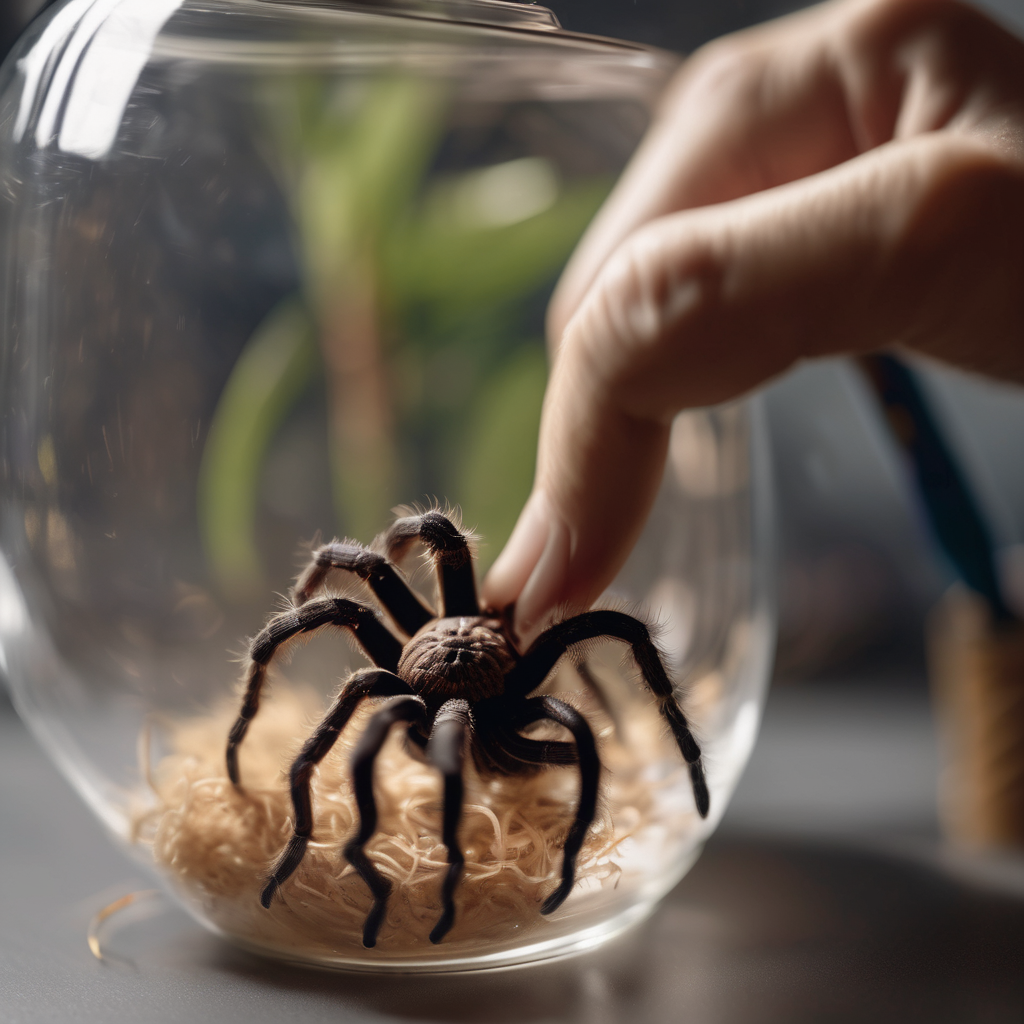
Every tarantula keeper eventually has to move a spider from one enclosure to another — you upgrade to a bigger tank, the old one cracks, you re-scape a bioactive setup, or a female needs a quieter space before she lays a sac. The transfer itself takes about fifteen minutes, and it is also the moment most tarantula injuries happen: a fall from two feet can rupture the abdomen, a startled spider can vanish behind a bookshelf in under three seconds, and a stressed animal can flick urticating hairs at your face or go into a fatal dehydration spiral afterwards. Done properly, rehousing is close to a non-event. Done casually, it is the fastest way to lose a spider you have raised for years.
This guide covers the whole process: how to prepare the new enclosure before you touch the old one, which capture method suits which species, how to keep the transfer at a safe height, what the first week after the move should look like, and exactly what to do if your tarantula bolts. It is part of the Pet Tarantulas: The Complete Care Guide series.
Before you start: prepare the new enclosure completely
The most common rehousing mistake is catching the spider first and building the new home second. If you have an animal loose in a room while you are still unpacking substrate and burying a heater, you have turned a fifteen-minute job into an hour of chase and an enormous amount of stress for the spider. Everything about the new enclosure must be finished and running before the spider comes out of the old one.
The new enclosure checklist:
- Correct size. Floor space matters more than height for terrestrial species; arboreal species need height and a secure cork bark climb. Check our tarantula enclosure setup guide for per-species minimums.
- Substrate in place and at the right moisture level. Dry it out or dampen it in advance — you cannot fix humidity with a spider inside.
- Hide and water dish positioned. Read hide and water dish placement so the spider finds shelter the moment it lands.
- Heating and thermostat verified. Run the new tank for 24 hours and confirm the warm zone holds temperature before moving the spider in.
- Lid latched and gaps checked. Slide a pen cap around every seam. A tarantula will find the millimetre gap you left for a cable and will leave through it the same night.
Once the new enclosure is warm, at humidity, and latched, you are ready to catch the spider.
How to catch a tarantula out of its enclosure
There are two reliable methods and one that is popular on video but genuinely risky. Choose based on the species and how much it wants to fight.
Method 1: the cup and brush method (best for most species)
Lower a clear cup or deli tub over the spider, wait for it to walk up the side, and slide a stiff card underneath. In an enclosure, the version of this that works better is to let the spider walk into an upturned tub that you place against its hide entrance, then lift the tub out with a lid slid under it. It is slow, it is calm, and it never puts a hand near the fangs.
For a spider out in the open, coax it gently with a soft makeup brush or a paintbrush towards the tub. Brushing is safe: the hairs on a brush trigger the same leg response as a substrate vibration, and the spider walks rather than bolts. Never touch the abdomen with the brush — only the back legs and rear body, and only from behind.
Method 2: the hand-cupping method (only for very docile species)
Some species — a Grammostola rosea, a Brachypelma hamorii, a Tliltocatl vagans — are calm enough to be walked onto an open hand. If you use this method, hold your hand flat and relaxed, keep it within centimetres of the substrate so the spider is never high in the air, and move at a steady walking pace with no sudden corrections. One twitchy moment at waist height is a fall. This method is not appropriate for Poecilotheria, Pterinochilus, Heteroscodra, or any Old World species you have not handled before.
What NOT to do
- Do not grab the spider by the cephalothorax with tweezers. Pinching the body between hard surfaces crushes book lungs and legs and is how spiders end up with a permanently deformed leg or a ruptured abdomen.
- Do not shake the old enclosure to move the spider away from the walls. You will either bury it in substrate or make it run — and a running tarantula is a tarantula that falls.
- Do not use your bare fingers to block an exit. A defensive species will bite, and a bite from a large Poecilotheria is a genuinely serious medical event.
The transfer itself: fall prevention is everything
A tarantula’s abdomen is a soft fluid-filled sac. A drop of more than a few times the spider’s own body length onto a hard surface can rupture it, and an internal rupture is not something you can bandage. The rules are simple:
- Keep the cup or your hand within 15 cm of a surface at all times — the floor of the old tank, the top of the new tank, or a table.
- Move the enclosures so you only have to lift the spider a few centimetres. Slide the new tank against the old one on a table and open both lids side by side.
- Lift the spider with a lid slid under the cup, not by pinching the cup walls. You cannot drop what is fully enclosed.
- Do the whole job sitting down, over a low table, with the room otherwise empty of other pets. A curious cat watching you lower a tarantula is a bad combination.
What to do in the new enclosure
Tip the spider out near the hide, or place the tub on the substrate at one end and let it walk out on its own — the second option is even calmer. Then leave. Do not watch, do not photograph, do not poke it to see if it settled. Tarantulas settle by going still and hiding, and a lid opening over them re-triggers the same defensive response you just spent ten minutes calming down.
Expect the spider to hide under the hide or part-bury itself for the first two to five days. That is normal relocation behaviour, not illness. Feed nothing for a week, even if the species normally eats weekly — a stressed tarantula will often refuse food anyway, and uneaten crickets can nip a spider that is trying to rest. Keep the water dish full, because dehydration is the real risk after a move.
Species notes for rehousing
- Arboreal species (Avicularia, Poecilotheria, Caribena): they will bolt upwards when disturbed. Lift the tub up to the new tank with the spider inside, open the lid, and let it climb out on its own. Never carry these at height.
- Fossorial species (Cyriocosmus, many Hapalopus): they will dig straight down. Place the tub on the substrate and walk away; chasing one with a brush just drives it deeper.
- Bald-legged / nervous New World species (Tliltocatl, Brachypelma): expect a hair-flick if you crowd them. Wear eye protection or work at arm’s length, and do not inhale after disturbing the abdomen.
- Aggressive Old World species: use a tub and a lid, never a hand, and rehouse during the day when the spider is usually at the back of its hide rather than at the entrance.
Rehousing a gravid female or one with an egg sac
Do not, unless you have no choice. A female carrying an egg sac is already stressed, the sac is fragile and can be damaged by substrate handling, and a dropped sac is usually fatal for the brood. If you must move a gravid female, move her entire old enclosure contents into the new one with her hide intact and uncrowded, and do it as fast and as low as physically possible. If she is tending a sac, postpone the rehouse until the spiderlings have dispersed.
Emergency: your tarantula escaped during rehousing
It happens. The sequence that recovers escapes:
- Contain the room first. Close the door, block the gap under it with a towel, and get children and other pets out. A tarantula can cross a room in seconds and climb a curtain.
- Lay traps. A shallow deli tub with air holes, a damp piece of paper towel, and a small hide placed against a skirting board works surprisingly often. Tarantulas seek dark, humid, enclosed spaces.
- Search downward-facing dark seams. Behind skirting, under furniture, inside shoe uppers, along the warm base of appliances, in piles of laundry. They are not usually in the middle of the floor.
- Turn the heating up slightly. A cold spider will be sluggish and easier to recover; a warm one will run.
- Give it time. Most escapes are recovered within 24 hours by placing traps and going to bed. A spider that has been loose for a day is almost always dehydrated and will go for the damp paper towel.
When you find it, do not grab. Slide the tub over it as you would in its enclosure.
Warning signs after rehousing
Most post-move behaviour is normal, but a few things need a vet or a change in husbandry:
- Abdomen shrivelled or wrinkled after a week. The spider is not drinking. Dampen a corner of the substrate and mist the side walls lightly, even for a terrestrial species, and check the humidity reading.
- Lying on its back with legs curled for more than 24 hours when it is not premolt. See tarantula molting guide to confirm what premolt actually looks like, because stress plus dehydration is the other common cause of a death-curl posture.
- Hair loss or a bald abdomen patch after the move. Urticating hairs have been kicked off, usually by repeated disturbance. Give the spider a completely dark, undisturbed week.
- Legs held oddly, or a drag in one leg. A fall during transfer has damaged a joint or an exoskeletal seam. Keep the spider warm and undisturbed; a lost leg is survivable, a crushed body is not.
- Not eating for three weeks after a move. Borderline normal for a moulting-cycle animal, but combined with weight loss it is worth reviewing humidity and temperature in the new tank.
For a broader picture of what healthy versus sick looks like, read how to tell if your reptile is sick and common illness warning signs.
Frequently asked questions
How often should I rehouse my tarantula?
Only when the enclosure is genuinely too small or damaged. Slings need upgrading every few months as they grow; an adult in a correctly sized tank may never need another move in its life. Every rehouse is a risk, so do not re-scape for aesthetics alone.
Can I reuse the old substrate?
For a healthy spider, yes — bake it at 200 °C for 30 minutes or freeze it for 72 hours to kill mites and mould spores first. If you have had a mite problem, discard it. See how to get rid of reptile mites.
My tarantula went into a threat pose when I opened the lid. Should I stop?
Yes, for that session. Close the lid, leave the room, and try again the next day — ideally in the morning. A spider in a threat pose will either flick hairs, rear up, or run, and all three make a safe transfer harder.
How long after rehousing should I wait before feeding?
One week minimum. If the spider is in premolt — check for a dull abdomen, a bald patch, and refusal of food — wait until after the moult regardless.
Is it OK to rehouse during a moult?
No. A moulting tarantula is completely vulnerable, cannot defend itself, and cannot be moved. Postpone everything until the new exoskeleton has hardened — typically one to two weeks after the shed.
The bottom line
Rehousing a tarantula is a controlled operation, not a cleanup task. Build the new home first, choose the gentlest capture method the species allows, never lift the spider higher than a few centimetres above a surface, and then leave it completely alone for a week. Most rehouses go badly because of hurry, not because of the spider. Take the extra ten minutes, keep the transfer low, and your tarantula will simply walk into its new home and hide — which is exactly the outcome you want. For the rest of tarantula husbandry, start with the complete tarantula care guide and the sling care guide.
Leave a Reply