
Reptile keeping is the only hobby where a two-dollar instrument decides whether the animal lives. You cannot see whether the air in your leopard gecko’s cool end has dropped to 18 °C overnight, and you cannot feel the difference between 45% and 65% humidity with your hand. So you measure — and if the measurement is wrong, every decision you make from that point on is wrong too. Most “my reptile stopped eating” and “my gecko has stuck shed” problems trace back to an owner who was confidently reading a thermometer that was five degrees off, or a hygrometer that had drifted 20 points without anyone noticing.
This guide covers the instrument types available, where to actually place a probe inside the tank, how to calibrate and sanity-check both temperature and humidity readings, and a short daily routine that catches drift before it hurts your animal. It is part of the reptile terrarium equipment series, and it works hand in hand with thermostats and humidity control.
The three types of thermometer, and what each one is for
1. Digital probe thermometer (the one that actually matters)
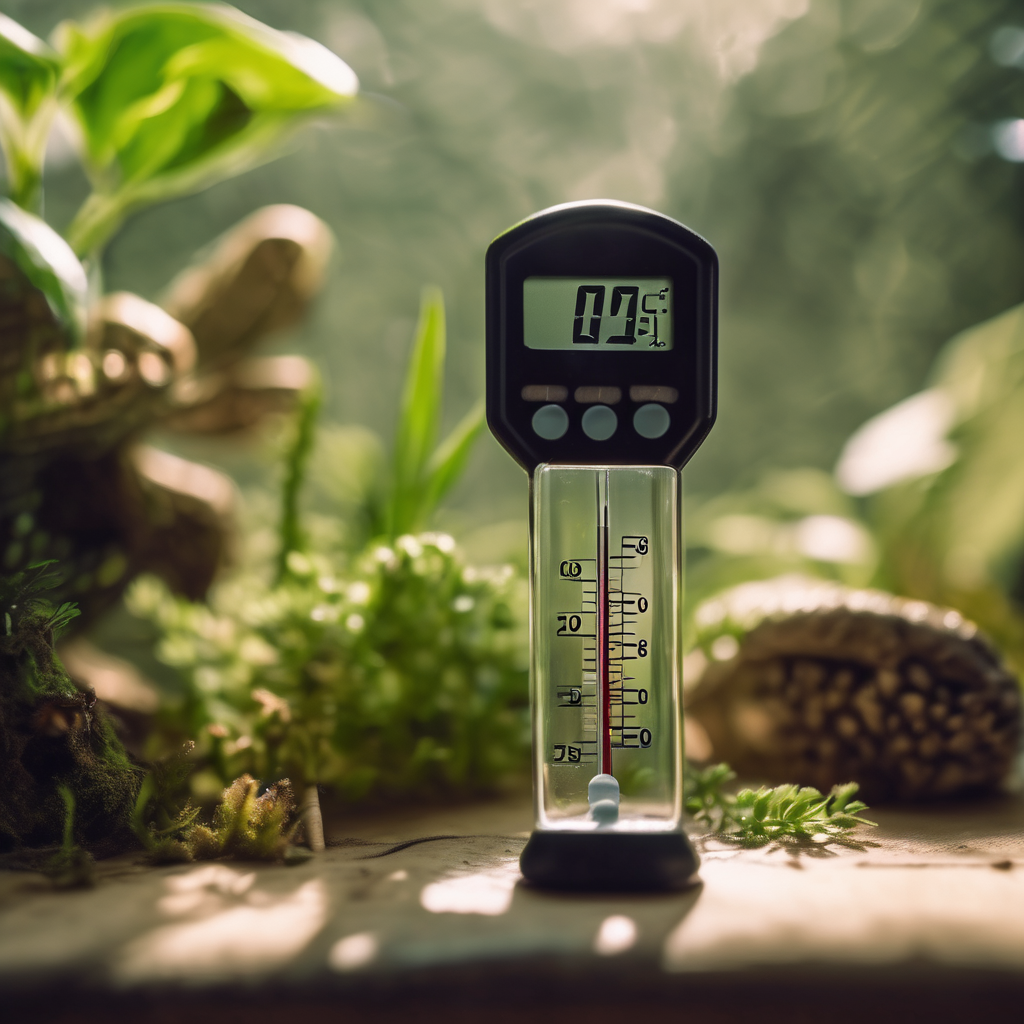
A digital probe thermometer is a base unit with a cable ending in a waterproof temperature sensor. You bury or clip the probe where the animal is — on the substrate surface, inside the hide, in the water for an aquatic setup — and the display sits outside the glass where you can read it. Many models add a second probe for humidity and high/low alarms.
This is the only category of thermometer that tells you about the place your reptile actually is. A heat source only matters if the animal can reach it and choose not to; the probe measures the choice, not the emitter. Look for a range of roughly -10 to +50 °C, a probe cable long enough to route out of the lid without pinching it, and replaceable batteries. Cheap two-probe units from the aquarium trade (typically USD 10–20) are genuinely adequate; the expensive branded versions add alarms and logging, not accuracy.
2. Infrared (non-contact) thermometer gun
An IR gun reads the surface temperature of whatever you point it at — a rock, a branch, the glass. It is the right tool for checking a basking surface, which no air probe can measure. It is the wrong tool for checking the air, because a sunbeam-warmed rock reads 20 degrees hotter than the air above it, and pointing the gun at the glass measures the glass.
Use an IR gun as a second instrument, not the first: once a week, check the hottest rock or the hottest hide floor to confirm your basking spot is in range, and check the cool end substrate for a baseline. Never control a thermostat off an IR reading — the gun measures an instant surface spot, and the thermostat needs a continuous signal.
3. Analog dial thermometer (stick-on or free-standing)
The adhesive circular dials sold in every pet shop are the least accurate instrument in the hobby. They are calibrated at the factory, then glued to the outside of a glass wall, then read through glass and water vapour, and they are often off by 3–5 °C within weeks. A dial stuck to the side of a tank tells you almost nothing reliable.
If you already have one, do not throw it out — use it as a cheap trend indicator. If the dial says 29 °C and your probe says 26 °C, and both move together, the dial is useful as a fast visual check. Just never make husbandry decisions from it alone.
Hygrometers: why they drift and what to buy instead
Every cheap analog hygrometer is a mechanical or capacitive device that is calibrated at one humidity and slowly goes out of calibration afterwards. A dial that reads 60% today can read 75% next month in the same room. That drift is not a fault — it is how the technology works — but it means an uncalibrated hygrometer is actively dangerous in a species like a crested gecko or a dart frog, where 10 humidity points is the difference between healthy and dehydrated.
The practical answer: use a digital probe hygrometer combined into the same unit as your thermometer. These are calibrated digitally, hold calibration far longer, and let you read humidity in the same glance as temperature. Budget around USD 15–30 for a two-probe digital unit. Keep one analog dial as a cross-check if you like, but treat the digital as the reference.
There is one genuinely reliable calibration method for humidity, and it takes twenty minutes:
- Mix 1/2 cup of table salt with a few teaspoons of water into a thick slurry in a small container — wet sand consistency, not soup.
- Seal the container and the hygrometer together in a zip-lock bag, and leave them at stable room temperature for 8–24 hours away from windows and radiators.
- The air above a saturated salt solution stabilises at 75% relative humidity. If your instrument reads 75%, it is accurate. If it reads 65%, it is 10 points low — adjust with the calibration screw/button if the model has one, or apply the offset in your head every time you read it.
Do this when the instrument is new, and again every three to four months. Write the offset on a piece of tape on the unit so you never forget it.
Where to place the probe: the placement rules that fix most “wrong” readings
Placement errors are more common than instrument errors. These rules cover nearly every setup:
- Measure where the animal is, not where the equipment is. A probe clamped 5 cm under a heat lamp reads the lamp’s exhaust air, not the animal’s world. Put the warm-side probe at substrate level in the open, or better, inside the warm hide.
- Two zones, two probes. A gradient only exists if you can see both ends. One probe on the warm side at substrate level, one on the cool side at substrate level. If your unit has a single probe, move it between zones on different days and record both numbers.
- Never place a probe in direct line of a heat lamp. Radiant heat cooks a probe the same way it cooks a lizard, giving a reading 5–10 degrees hotter than the air the animal experiences. Aim it at the floor of the basking area, with the bulb overhead and the probe beside the animal’s path, not under the beam.
- For burrowing species, measure at burrow depth. For a sand boa or a desert scorpion, the number that matters is 10 cm down. Clip a second probe so its tip sits at the bottom of the burrow.
- For aquatic and semi-aquatic setups, the water probe is submerged and the humidity probe is not. A humidity sensor in a frog’s water reads 99% and stays there. Put the humidity probe in the land area, near the moist hide, and the temperature probe in the water itself.
- Keep the humidity probe off the glass. Condensation on the side wall skews the reading badly. Position it in free air, mid-tank, at the animal’s resting height.
- Route the cable without pinching it. A cable crushed under a mesh lid eventually fails and gives a permanent reading of a fixed number — usually a plausible one. That is the most insidious failure mode in the hobby.
Target numbers, and how to read them as a gradient
A single number is meaningless; you need the range. For most commonly kept reptiles, the working ranges look like this (always confirm against the care guide for your exact species):
- Warm-side air temperature: 29–32 °C for desert species, 26–29 °C for tropical and forest species.
- Cool-side air temperature: 5–6 °C below the warm side is a healthy gradient. Less than 3 degrees means you have no gradient, and the animal cannot thermoregulate.
- Basking surface temperature: 35–40 °C for a leopard gecko or bearded dragon, measured with the IR gun on the rock itself.
- Night-time drop: 3–5 °C below the daytime warm side for most diurnal species, and down to room temperature (21–24 °C) overnight for many desert species.
- Day humidity: 30–40% for arid species, 60–80% for most tropical and semi-aquatic species. The night rise is what matters more than the day figure — a species that needs a night spike to 80% and never gets it will dehydrate over weeks.
If your two readings are within 2 degrees of each other, your gradient has collapsed. That usually means the enclosure is too small, the heat source is too powerful, or the cool side has no shade — all fixable problems, but only if the measurement tells you they exist.
The daily and weekly checking routine
Instruments need to be read like a dashboard, not installed and forgotten. This is the routine that catches 95% of husbandry failures before they become vet bills.
Every day (60 seconds, at the same time): read both temperatures and humidity and say them out loud or write them down. After two weeks you will know your tank’s normal numbers by heart, and a deviation will stand out immediately. Check that the readings move in the direction you expect — warm side warmer than cool side, humidity rising after misting, falling overnight.
Every week (five minutes): IR-gun the hottest basking surface and the cool-end substrate. Compare the surface reading with your warm-side air probe — the surface should read hotter than the air, and the gap should be roughly stable. A shrinking gap means the bulb is ageing or the thermostat is failing. Confirm the probe cable is still where you left it (a curious snake will move it).
Every month (ten minutes): replace batteries in the digital unit, even if the display looks fine — a low battery is a common cause of readings that quietly drift. Check your instrument against a known reference: a room thermometer for temperature, and the salt-slice method or a second known-good hygrometer for humidity.
Every season: re-check everything. Room temperature swings between summer and winter change your tank’s cool-end floor and your heater’s duty cycle. The seasonal care guide explains what to adjust and when.
Warning signs: when the instrument is telling you something is wrong
Treat any of these as an immediate husbandry problem, not a next-weekend project:
- Both zones read within 2 °C of each other — no gradient, the animal cannot thermoregulate.
- Warm side reads below 26 °C for a tropical species — digestion slows, immune function drops, chronic low-grade illness follows.
- Warm side spikes above 35 °C air temperature — overheating risk; a reptile cannot sweat and will overheat in a small enclosure before you notice.
- Humidity stuck above 85% for an arid species — scale rot and respiratory infection risk, covered in the scale rot guide.
- Humidity below 30% for a tropical species — dehydration and stuck shed, which in turn leads to lost toes and tail tips.
- A reading that never changes — a failed probe or a flat battery. The single most dangerous instrument is one that reports a believable constant.
- Sudden drops overnight — check whether the room itself has cooled (a closed door, a cold night) or whether a heat bulb has blown.
If you have fixed the readings and your animal is still off — not eating, hiding constantly, weight loss, abnormal shedding — the cause is no longer environmental. Read how to tell if your reptile is sick and book an exotic vet visit. Do not spend weeks adjusting numbers while a treatable infection progresses — and remember that poor UVB provision can produce the same slow decline as a wrong temperature.
Common measurement mistakes
- Trusting the dial on the side of the tank. Replaced by a probe, most hobbyists find their real temperatures were 3–5 degrees off for months.
- Reading only after misting. Humidity readings right after a spray are 15–20 points higher than the resting value. Read an hour after misting, and again before the next misting, and manage the low number.
- Measuring the heat emitter instead of the tank. Your gecko does not bask on the bulb.
- Assuming the room temperature is the tank’s cool end. A tank against an external wall in winter can run several degrees colder than the room thermometer says.
- Never calibrating, then blaming the animal. “He just won’t eat” is often “his cool end is 15 °C”.
Checklist: instrument setup in ten minutes
- Buy one digital two-probe unit (temperature + humidity) with a long waterproof probe.
- Add an IR thermometer gun for surface checks — useful but secondary.
- Place probe 1 on the warm side at substrate level, out of the direct beam.
- Place probe 2 on the cool side at substrate level, in free air.
- For burrowers, add a third probe at burrow depth; for aquariums, submerge one probe and keep the humidity probe in the land area.
- Salt-calibrate the hygrometer and record the offset on tape.
- Cross-check temperature against a known room thermometer.
- Read both numbers daily for two weeks and write them down.
- Weekly: IR the basking surface and compare with the air probe.
- Monthly: batteries, re-calibration, and confirm the probe has not been relocated by the animal.
Frequently asked questions
Do I need both a thermometer and a hygrometer, or is one enough?
Both. Temperature controls metabolism and immune function; humidity controls shedding and hydration. A failure in either produces different diseases, and you cannot see either one with your eyes. The good news is that digital units combining both cost about the same as a decent thermometer alone.
Is an infrared thermometer better than a probe?
They answer different questions. The IR gun measures a surface at one instant — ideal for a basking rock. The probe measures the air continuously over time at one location — ideal for the place your animal sits. For a complete picture you want one of each, and the probe is the more important of the two.
How often should I calibrate my hygrometer?
When new, then every three to four months, using the salt-slurry method. Digital units drift far less than analog ones, but “far less” is not “never”. If your species has tight humidity requirements — dart frogs, cresties, most amphibians — treat quarterly calibration as mandatory, and cross-check with a second instrument if you can.
Can I control my thermostat with a hygrometer reading?
No — humidity is controlled by substrate moisture, misting and ventilation, not by heat. A thermostat switches a heat source; humidity management is a separate system. The automation guide shows how the two run side by side without interfering.
My probe reads a believable number that never changes. Is that normal?
No. A probe that reports a constant across a full day-night cycle has failed — usually a pinched cable, a flat battery, or water damage. Wiggle the cable while watching the display: if the number flickers, the cable is the fault. Replace the unit rather than trust it.
Where exactly should the warm-side probe go for a leopard gecko?
On the floor of the warm hide, not in the open and not under the bulb. Ground-dwelling species experience the temperature of the surface they lie on, and the hide is where they spend their warm period. Cross-check with an IR reading on the hide’s floor once a week.
Does tank placement change my readings?
Yes, significantly. A terrarium near a window gains radiant heat during the day and loses it at night; one against an external wall runs cold in winter. Where you put the tank changes your cool-end floor, so measure in the final location before adjusting your heat source.
Bottom line: buy one good digital two-probe unit, place it where the animal lives, calibrate the humidity sensor quarterly, read it daily for two weeks until you know your numbers by heart, and never make a husbandry decision from a dial glued to the glass. Most reptiles that “just got sick” were living in conditions their owner could not see.
Leave a Reply