
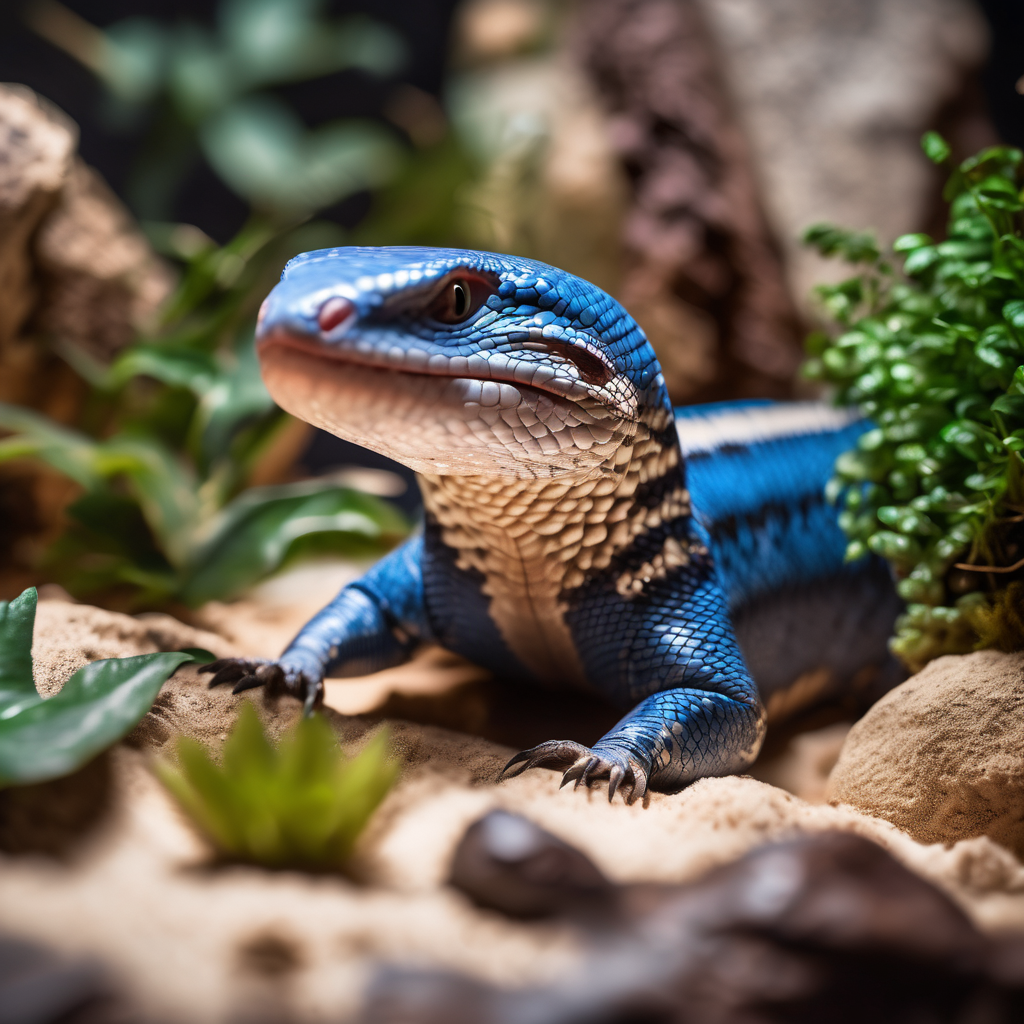
If you have landed on this page because you are thinking about adding a blue-tongued skink to your family, or because your new Tiliqua has stopped eating and you are not sure why, you are in the right place. Blue-tongued skinks are not the compact lizards they look like in a photo — adults reach 18 to 24 inches, live 15 to 20 years, and they are herbivorous-omnivorous grazers that need a diet as carefully balanced as a tortoise’s and a basking lamp as steady as a bearded dragon’s. Getting one of these deliberate, almost dog-like lizards means accepting a 20-year commitment and setting up an enclosure that can hold a stable thermal and humidity gradient for decades.
This guide walks you through everything a responsible keeper needs before bringing a blue-tongued skink home: which species suits a first-timer, how to build and heat an adult-sized setup, what the diet really looks like (it is not just “a pinkie a week”), how to use UVB and calcium correctly so the bones stay strong, and the red-flag symptoms that mean a reptile vet visit today. It belongs alongside our guide to bearded dragon beginner setup and our leopard gecko care checklist for the full picture on diurnal lizard husbandry.
Which blue-tongued skink is right for you
The name “blue-tongued skink” covers several Tiliqua species and a long list of subspecies, and the differences between them matter for a first setup — mainly because adult size, humidity, and dietary drift change what you build from day one. The northern blue-tongued skink (T. scincoides), the most common in the pet trade, is the hardiest for beginners: it reaches 18 to 20 inches, is docile once acclimated, and tolerates a fairly dry setup that keeps the enclosure simple. The western or shingleback skink (T. peronii) is larger, needs higher humidity, and is a more advanced keeper project.
If you are buying your first skink, stick to a captive-bred northern from a reputable breeder in your own country. Avoid any import labeled “blue-tongued” with no species breakdown — many of those turn out to be T. gigas, which needs far more humidity and grows substantially larger. Captive-bred northern skinks feed reliably, adapt quickly, and their calm temperament is what made the species famous. A wild-caught skink, by contrast, usually arrives stressed, loaded with parasites, and may never feed on cue — which for a lizard that can go weeks without eating is a slow path to a vet bill.
Setting up the enclosure
An adult blue-tongued skink needs an enclosure at least 4 feet long by 2 feet wide and 2 feet tall — a 40-gallon breeder is the absolute minimum for a juvenile, and most keepers move to a 75-gallon or a custom 4x2x2 as the skink nears full adult size. Juveniles can start in a 20-gallon long, but plan the upgrade before the lizard hits 12 inches. The enclosure must hold a proper thermal gradient: a basking surface at 95 to 100 degrees Fahrenheit measured with a digital probe or a temp gun, and a cool end that stays at 75 to 85 degrees. A single skink needs to be able to move freely between the two ends at ground level, which means the cool side must be a full two feet wide, not an afterthought corner.
Heating comes from an overhead basking bulb (a 75 to 100 watt incandescent or halogen spot, depending on distance and room temperature), controlled by a thermostat — never a basking bulb plugged straight into the wall. The thermostat probe belongs at the basking surface, and you verify the gradient at floor level where the skink rests. A ceramic heat emitter is useful for night warmth if the room drops below 70, but it must sit behind the same thermostat and on a separate dome so you can run night and day cycles independently. Our terrarium equipment guide walks through every piece of hardware and why the order matters.
Substrate is where skinks diverge from many other beginner lizards. Blue-tongued skinks are ground-dwellers that dig, so they want a diggable surface — a 60/40 mix of organic topsoil and playsand, cypress mulch, or a commercial bioactive blend. Avoid loose sand alone (compaction risk), cedar and pine (respiratory irritants), and loose bark that can splinter. A substrate depth of 3 to 4 inches lets a skink dig, and it holds humidity for the weekly soak. Spot-clean feces daily and replace the top layer monthly; a full substrate change every 3 to 4 months keeps bacterial load down.
Two hides are mandatory: one on the warm end and one on the cool end, both just large enough for the skink to fit its whole body inside. A humid hide — a plastic container with a lid and a damp (not soggy) paper towel or sphagnum moss inside — gets used most heavily during a shed, which is why the enclosure humidity needs to sit in the 40 to 55 percent range. Use a good digital hygrometer placed at the skink’s resting level, never the sticky dial kind that sits in a corner and lies about the number.
Temperature, lighting, and UVB
This is where blue-tongued skinks stop being “beginner friendly” and start requiring real equipment discipline. Unlike a ball python or a king snake, a blue-tongued skink genuinely benefits from UVB — the species synthesizes vitamin D3 poorly from diet alone, and without a proper UVB dose the bones soften over months into metabolic bone disease that can only be slowed, not reversed. Mount a 10.0 or 10.8-watt linear fluorescent UVB tube (T5 HO) on the basking side, set on a 12 to 14 hour timer, and replace the bulb every 6 months whether it still lights or not — UVB output drops long before the filament burns out. Our UVB lighting guide explains the difference between outputs and why a 10.0 is the right call for a diurnal lizard like this one.
The basking light runs on the same day schedule as the UVB and gives you your photoperiod: 12 to 14 hours of light across summer, tapering to 10 to 11 across winter to signal brumation, if your skink brumates at all. Night heat, if needed, comes from a ceramic heat emitter mounted behind a second thermostat — a skink that loses its warm side overnight because the room got cold will begin a stress response that suppresses appetite and immunity. Do not use colored “night” bulbs; skinks see them as daylight and it disrupts their cycle. If you want a night bulb for your own viewing, use a red one sparingly and only with the thermostat controlling the ceramic.
Measure everything at ground level. A basking surface that reads 100 at the lamp but 75 at the substrate is useless — the skink lives on the floor. Calibrate two digital probe thermometers: one at each end of the gradient, held down on the substrate with a rock or clamp. Replace batteries every season. An inexpensive infrared temp gun is the single best tool for checking the basking spot because it reports surface temperature, not air temperature, and skinks conduct heat from what they touch.
Diet and feeding
Blue-tongued skinks are opportunistic grazers and insectivores, and their adult diet is roughly half plant matter and half animal matter by volume, not the rodent-heavy diet a snake or a bearded dragon gets. For an adult, a typical weekly ration looks like this: two to three servings of dark leafy greens (kale, collards, dandelion, mustard greens) lightly cooked or pulsed, a small portion of low-oxalate vegetables (squash, bell pepper, carrot, green beans), one to two servings of protein (a large superworm, a hornworm, or a tablespoon of plain-cooked egg or chicken once a week), and a piece of low-oxalate fruit (mango, blueberry, or papaya) once or twice a week. The key word is “portion” — skinks will absolutely gorge on squash and superworms and then sit fat and idle for weeks.
Calcium is the non-negotiable part of the diet. Dust every plant-based meal with a calcium-only powder (no phosphorus), and dust every animal-based meal with a calcium-and-vitamin-D3 mix — but only when the UVB is running, because giving D3 to an animal that also makes it from UVB risks overdose. On off-days, dust with a plain reptile multivitamin. Gut-load your insects for 24 hours before offering them, and never feed a wild-caught or unidentified bug. Our feeder-insect gut-loading guide covers the kitchen scraps and timing that actually matter for nutrition.
Feeding frequency drops with age but should never stop entirely. Juveniles under a year eat every day; subadults at five to eight months eat every other day; adults eat three to four times a week. A healthy adult skink in the photos above is rounded but not bloated, with a clear demarcation between body and tail — a skink whose tail is thicker than its body has been underfed, and one whose sides balloon outward has been overfed. Feed in the morning and remove uneaten food after one hour; a skink that leaves greens overnight will usually finish them by midday.
Water, humidity, and shedding
Water for a blue-tongued skink is a shallow bowl large enough for the whole body but weighted so it cannot tip, changed daily, and scrubbed weekly. Most skinks will soak and defecate in their water bowl, which is normal — the lizard is using the moisture both to hydrate and to pass waste comfortably. A skink that avoids its water bowl entirely, or that visibly strains in the bowl without producing, is a dehydration or impaction warning sign that needs attention before it becomes a vet visit.
Humidity for a northern blue-tongued skink sits around 40 to 55 percent, which is exactly what a weekly soak and a properly maintained humid hide produce. If the enclosure uses a screen-top tank and the room itself is dry, aim a small room humidifier at the enclosure during winter months and watch the hygrometer climb into range. A blue-tongued skink that is shedding poorly — retained eye caps, bits of skin stuck on the tail tip — is almost always a humidity problem, not a nutrition problem, and the fix is correcting the humid hide and substrate moisture, not a vitamin bath. A full-body shed should come off in one piece within three days of the blue stage.
Handling and daily care
Blue-tongued skinks are as close to a dog as a lizard gets: they recognize their keeper, will often greet you at the enclosure door, and some learn to take food from tongs. But that personality comes with a caveat — a skink that feels cornered will not “play dead” the way a hognose does; it will bluff with an open mouth and a blue tongue, and if the bluff is ignored it can deliver a serious bite. Never grab a defensive skink. Wait it out, or use a large towel to gently encourage it onto your hand from behind. Once calm, support the entire body and tail — a skink that dangles by the tail risks dropping it, and a dropped tail (autotomy) is a weeks-long healing process that rarely regenerates cleanly.
Daily care is a 5-minute visual exam and a 15-minute spot-clean. Check that the water is fresh, that no uneaten food is molding in the corners, that the basking light came on at the right time (a simple plug-in timer is your friend), and that the skink is responsive and moving normally. Weekly, wipe down the glass with a reptile-safe disinfectant, refresh the humid hide lining, and confirm the substrate is not building up a sour smell. Monthly, deep-clean the whole enclosure with the skink safely tubbed elsewhere — this is the only way to catch an early impaction, a patch of scale rot under a decoration, or a heat-source failure before it becomes a crisis.
Common health problems and when to worry
The single most common health problem in captive blue-tongued skinks is metabolic bone disease, and it is entirely preventable with the right UVB, the right calcium schedule, and a phosphorus-controlled diet. Early signs are subtle: a slightly soft jaw, reluctance to climb onto the basking rock, or a skink that has stopped taking its calcium-dusted greens. Left to advance, MBD causes the toes to curl inward, the tail to develop a sideways bend, and eventually fractures that will not heal. A vet who knows reptiles will take an X-ray and a blood calcium reading; the fix is correcting the setup and, in severe cases, supplemental calcium injections — but prevention is hours of work, treatment is months.
Respiratory infections are the second most common issue and usually trace back to the enclosure being too humid with poor air flow, or a basking bulb that failed overnight without the keeper noticing. Watch for a speck of mucus at the nose, a slightly open mouth at rest, or a skink that hangs out on the cool side instead of basking. Our emergency warning signs guide breaks down the progression — once a skink is gaping audibly at rest, the infection is advanced and needs immediate veterinary care with injectable antibiotics. Prevention is a stable 70 to 75 degree night temperature and daily observation of activity level.
Obesity is the third silent problem and it is epidemic in blue-tongued skinks because they will happily accept a fourth helping of squash and a third superworm. A healthy adult has a defined waist when viewed from above and a body that tapers toward the tail. A skink whose sides bulge or whose tail base is thick and smooth is carrying excess weight, which stresses the spine, suppresses appetite, and makes brumation dangerous. The fix is portion control and more activity, not starvation — cut the protein portion in half and add a climbing branch or foraging box so the skink works for its food.
Pre-arrival checklist
- 40-gallon breeder (juvenile) or 75-gallon/4x2x2 enclosure (adult), with a secure screen lid — skinks are strong climbers and escape artists.
- Overhead basking bulb (75-100W) on a thermostat with the probe at the basking surface, plus a ceramic heat emitter for night if rooms get cold.
- Two digital probe thermometers or one temp gun, placed at substrate level on each end of the gradient.
- Linear 10.0 UVB fluorescent tube on a 12-14 hour timer, replaced every 6 months.
- Two hides (warm and cool) plus a humid hide with damp sphagnum moss, checked weekly.
- Dish/water bowl large enough to soak in, weighted, changed daily and scrubbed weekly.
- Diggable substrate (topsoil/playsand mix, cypress, or bioactive blend) 3-4 inches deep, no cedar or pine.
- Hygrometer placed at the skink’s resting level, aiming for 40-55% humidity.
- Balanced diet items: dark leafy greens, low-oxalate vegetables, protein (insects/cooked egg), and fruit, plus calcium and multivitamin powder.
- Long-handled feeding tongs, a reptile-safe disinfectant, and a secure transport tub for vet visits.
Frequently asked questions
Are blue-tongued skinks good beginner lizards?
They are intermediate, not starter lizards — the diet and UVB requirements are more demanding than a bearded dragon’s, but the handling temperament and feeding reliability make them forgiving once the setup is correct. If you are committed to the full 20-year lifespan and the daily feeding prep, yes. If you want something you can feed once a week and forget, no.
How big do blue-tongued skinks get and how long do they live?
Adult northern blue-tongued skinks reach 18 to 24 inches total length and weigh roughly one to one and a half pounds. Lifespan in captivity is 15 to 20 years, with some individuals living into their mid-20s when properly housed. A 4x2x2 enclosure is future-proof for a single adult.
Do blue-tongued skinks need UVB lighting?
Yes, more than almost any other commonly kept pet lizard. They synthesize vitamin D3 poorly from diet alone, and without a proper UVB source the bones soften over months into metabolic bone disease. A 10.0 linear fluorescent tube on a 12 to 14 hour cycle, replaced every six months, is the minimum safe standard.
Why is my blue-tongued skink not eating?
The most common causes are a temperature that is too low, a basking bulb that failed, stress from a new enclosure, an impending shed, or simply an adult that is full. A juvenile that skips more than three days of food, or an adult that refuses food for a week, needs the setup checked and a vet consulted if the body condition is dropping. Never force-feed without a vet’s instruction.
Can blue-tongued skinks be house-trained?
They are not house-trained in the mammalian sense, but a consistent routine helps: feed in the morning, and a skink that has finished eating will usually defecate within a few hours in the same corner or in its water bowl. Many keepers place a small tile or newspaper under the water bowl as a “bathroom” zone and spot-clean it daily. This is habit, not bladder control.
How often should I soak my blue-tongued skink?
Bathing is most important during a shed and for juveniles, who dehydrate faster. A lukewarm (85 to 90°F) soak for 15 to 20 minutes, no deeper than the skink can stand comfortably, once or twice a week supports hydration and digestion. An adult that is eating well and passing naturally does not need a forced soak every week — but a soak during a stuck shed is essential.
The bottom line
A blue-tongued skink is a long-term, high-engagement pet: not quite a dog, not quite a houseplant, and entirely rewarding for keepers who commit to the setup discipline. The payoff is a lizard that recognizes you, takes food from tongs, and will happily sit with you while it grazes on a squash flower. The work is front-loaded — build the gradient before you bring the skink home, install the UVB before day one, and stock the calcium before the first meal. Watch for the early warning signs, a pale tongue, a reluctant bask, a jaw that feels soft — and you will keep that brilliant blue smile healthy for two decades. If anything looks off, trust the vet visit over the “it will probably be fine” instinct; the emergency signs guide tells you which flags can wait and which cannot.
Leave a Reply