
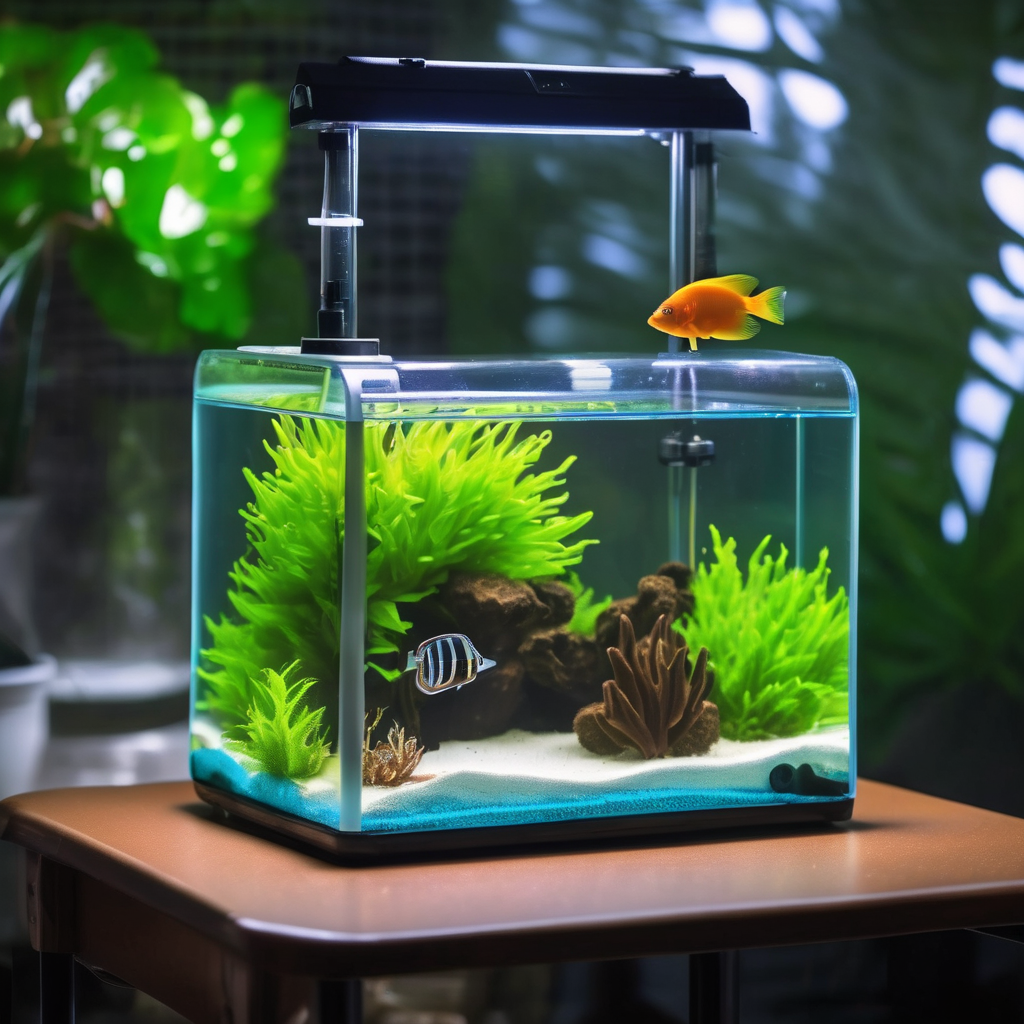
Almost every fishkeeper learns the same lesson the expensive way: you buy six new fish, drop them into a beautiful established display tank, and two weeks later the whole tank is covered in white spots. The new fish were not the problem. The problem was that they arrived from a system that had already seen every common pathogen, and your tank had not.
A quarantine tank (a QT, in hobby shorthand) breaks that chain. It is a cheap, bare, separate tank where every new arrival lives for several weeks before it is allowed near your display animals. It is the single highest-return piece of equipment in the hobby, and the one most keepers skip because setting up a second tank feels like work.
This guide covers everything: what size QT you actually need, what has to be in it, what you deliberately leave out, the observation timeline, when to medicate and when to simply wait, and how to judge that a fish is safe to move.
What a quarantine tank is for
Two jobs, and they are not the same:
- Disease screening. A new fish may carry ich, velvet, columnaris, flukes, internal parasites or a bacterial load with no visible symptoms for days. The QT gives those symptoms time to appear while the fish is somewhere cheap and easy to treat.
- Acclimation and observation. A fish that has been in a bag, then a shop tank, then your car, needs a quiet place to eat properly, put on weight, and stop behaving like a frightened animal. It is much easier to notice that a fish is not eating when it is the only animal in the tank.
If you have only ever kept a single betta and buy replacements one at a time, you can run a scaled-down version of this in a 20-litre tub. If you keep a community display, a permanent 40-60 litre QT is one of the best purchases you will make.
What you actually need
A QT is deliberately minimal. It is a hospital, not a habitat.
| Item | What to use | Why |
|---|---|---|
| Tank | 40-60 L (10-15 gal) glass, or a plastic tub of the same volume | Big enough for a group of small fish to settle; small enough to dose medication accurately |
| Filter | Air-driven sponge filter, oversized for the volume | Gentle flow, biologically active immediately if seeded, and it will not suck up medication powders or damage fins |
| Heater | Reliable adjustable heater, set to the display tank temperature | Same temperature means no shock at transfer |
| Light | Basic LED on a timer, or room light only | A day-night cycle reduces stress; strong planted-tank lighting is wasted here |
| Thermometer | Standalone digital or glass thermometer | Heater dials lie; verify the actual temperature |
| Test kit | Liquid test kit for ammonia, nitrite, nitrate and pH | A QT with a new sponge filter and daily feeding still produces ammonia on day 3 |
| Substrate | Bare bottom, or a thin layer of inert gravel | Bare glass lets you see waste, uneaten food and early symptoms instantly |
| Hide | One piece of smooth PVC pipe, a terracotta pot or a plastic plant | Stress suppresses immunity; a hide cuts stress without hiding the animal permanently |
| Net and hospital tub | A QT-only net plus a small floating tub or a separate 5 L tub | Nothing from the QT ever touches the display tank or vice versa |
What you leave out matters as much as what goes in: no live plants (they complicate medication and some medications kill them), no expensive hardscape, no algae problem to manage, and above all no invertebrates and no display-tank residents. Copper, formalin and many other common QT medications are lethal to shrimp, snails and scaleless fish.
Setting it up: three routes
1. The dedicated permanent QT (best)
A tank that lives permanently, cycled, with a sponge filter that never gets turned off. Water comes from your display tank during water changes, so the QT is always matched to the main system. This is what every serious keeper ends up with, and it is worth buying the tank for even if it sits empty for months.
2. The seeded borrowed-filter QT (fastest to start)
Run a spare sponge filter in your display tank for a couple of weeks before you need it. When a shipment arrives, move the seeded sponge into the bare QT with some of the display water and you are biologically ready on day one. This is the single biggest time-saver in fish quarantine.
3. The from-scratch QT (what most people actually do)
New tank, new sponge filter, no biological history. It works, but you are doing fish-in cycling with already-stressed animals. Manage it deliberately:
- Feed lightly for the first ten days – a quarter of the normal ration.
- Test ammonia and nitrite every day for the first two weeks.
- Do a 25-30% water change the moment ammonia reads above zero.
- Use a water conditioner that binds ammonia as well as chlorine, and dose it at every change.
If you are new to the nitrogen cycle, read how to cycle a fish tank before your first QT run so you recognise what the test readings mean.
The observation window
Four to six weeks is the standard, and the length is driven by parasite life cycles rather than caution:
| Week | What you are looking for | What you do |
|---|---|---|
| 1 | Transport stress: clamped fins, hiding, pale colour, not eating | Dim the light, keep it quiet, offer small live or frozen foods. Do not medicate yet. |
| 2 | Ich (white spots the size of salt grains), flashing against objects, rapid breathing | Raise temperature slowly to 27-28 degrees C and treat; see the ich treatment guide |
| 3 | Velvet (fine gold dust rather than white), cloudy skin, gill damage | Dim the light completely and treat; velvet kills fast in a bare tank with bright light |
| 4 | Frayed or melting fins, white mouth edges, cotton-like growth | Bacterial or fungal – treat alongside water quality; see fin rot causes and treatment |
| 5-6 | Internal parasites: weight loss despite eating, white stringy faeces, hollow belly | Treat with medicated food if suspected; finish any course fully before transfer |
Do not cut the window short because the fish looks fine on day 20. Ich in particular can sit below the visible threshold for weeks at lower temperatures, and the whole point of the QT is to catch what the shop tank could not.
Feeding in quarantine
Feed once or twice a day, small amounts, and remove everything uneaten after five minutes. Use a variety so you can see what the fish actually wants:
- Quality frozen foods (bloodworm, daphnia, brine shrimp, mysis) thawed and rinsed – the best appetite test and the best nutrition for a stressed fish.
- A small amount of high-quality dry food as the baseline, so you are not dependent on frozen stock.
- Live foods only if you trust the source, since live foods carry their own parasite risk.
Feed more than in the display tank, not less. A quarantined fish should visibly gain weight over six weeks. If it is eating well and still losing condition, suspect internal parasites rather than a feeding problem. Keep the temperature stable while you do this – a heater that swings will stress fish as much as bad food does, so check how to size and place an aquarium heater if your QT runs cool at night.
Water quality and maintenance
A bare bottom means you can see everything, so maintenance is easy but non-negotiable:
- Daily: look at every fish for two full minutes. Behaviour changes before symptoms do.
- Daily: siphon visible waste and uneaten food off the bottom.
- Weekly: 25-30% water change with temperature-matched, dechlorinated water.
- Weekly: test ammonia, nitrite, nitrate and pH.
- Monthly: rinse the sponge in removed tank water, never tap water, and never both sponges at once.
Match the QT water to the display tank for pH and hardness from the start. A fish that spends six weeks at pH 6.5 and then gets moved into pH 7.8 water is more stressed by the transfer than by anything that happened in the shop. If you are unsure what your tap water does, this water change guide covers matching parameters properly.
To medicate or not to medicate
This is the decision most keepers get wrong in one of two directions.
Do not medicate a healthy-looking fish just in case. Broad-spectrum treatments stress fish, crash biological filtration, kill plants and invertebrates, and select for resistant pathogens. A course of medication run without a diagnosis also hides the real problem.
Do not wait once symptoms appear. Ich and velvet progress in days, not weeks. The moment you see spots, dust or flashing, treat.
What is worth doing prophylactically, and what experienced keepers debate:
- A general parasite preventative after high-risk shipments (wild-caught fish, pond fish in summer, fish from a tank with visible disease). This is a reasonable trade, not a rule.
- Nothing at all for healthy captive-bred fish from a reputable source. Observe and react.
- Full treatment courses always run to the end. Stopping when the spots disappear is how resistant ich comes back two weeks later in your display tank.
Two practical warnings. First, most QT medications reduce the oxygen in the water, so run an air stone whenever you dose anything. Second, carbon in any filter will absorb medication – during a course, remove carbon and leave only the sponge. If you run a canister in your main system, the same rule applies there during treatment.
Rules that keep the QT from becoming the source
The QT only works if it is genuinely isolated:
- Separate equipment. Nets, algae magnets, buckets, siphons and your hands. Nothing moves between tanks.
- QT last. Do the display tank maintenance first, the QT last, then wash your hands and arms.
- Never share water. Water goes from the display tank to the QT, never back.
- Drain the QT to the garden or the drain, not into a sink you then use for display tank cleaning.
- Disinfect between batches with a dilute bleach solution, thoroughly rinsed and dechlorinated before the next group.
If you already have invertebrates in your main tank, treat the QT as fully off-limits to copper-based medications, and choose alternatives carefully with your fish supplier’s advice.
Getting the fish into the QT in the first place
Do not tip shop bag water into your QT. Float the sealed bag for 15-20 minutes to equalise temperature, then either drip-acclimate over 30-45 minutes for sensitive species, or net the fish out into the QT directly for hardy species. The bag water can carry a heavy pathogen load and should be discarded.
For a group, acclimate in a bucket with the heater from the QT sitting in it if the volume is large, so the whole group arrives at the same temperature.
When can fish move to the display tank?
All of these must be true:
- The full four-to-six week window has passed with no symptoms.
- Every fish is eating confidently and gaining weight.
- Any medication course was completed and its recommended waiting period has elapsed.
- Ammonia and nitrite have read zero for the last week.
- The display tank parameters are within the same range as the QT.
- The transfer happens with the lights off, and the display tank is left undisturbed for a few hours afterwards.
Move them in the evening, feed nothing beforehand so aggression over new arrivals is not amplified by food competition, and check on the display tank the next morning. For the transfer itself, the same principles as settling a new reptile into quarantine apply: quiet, stable, minimal handling.
Warning signs that mean a fish is not ready to move
Some findings mean the fish goes back into treatment rather than into your display tank:
- Any white spot, even one, at any point in the window – restart the clock from the last visible symptom.
- Rapid breathing or gills that move visibly faster than tankmates, with no clear cause.
- Frayed fin edges, white mouth margins or cotton-like growth that has not clearly improved.
- A fish that has not eaten for more than 48 hours in a settled QT.
- Visible weight loss – a hollow belly or a head that looks too large for the body.
- Stringy, pale or unusual faeces persisting after a deworming course.
- Behaviour that stays abnormal – hanging at the surface, shimmying, spiralling – with no matching water parameters.
Fish vets are genuinely specialised, and most of the time a well-read keeper can handle the common pathogens. When in doubt, a photo and a short video of the affected fish sent to an aquatic vet is worth more than three guesses with three different medications.
Cost reality check
A 40-litre QT, a sponge filter, a heater, a thermometer and a test kit is a modest one-off purchase. It is far less than one outbreak of ich in an established 300-litre display tank – where you lose the fish, treat the whole tank, deal with the algae bloom that follows medication and stress, and often restart the cycle. If you buy fish regularly at all, the QT pays for itself the first time you use it.
Checklist: your QT, ready to use
- Tank of 40-60 L (or a tub of the same volume), bare or thin gravel
- Air-driven sponge filter, oversized, cycled or seeded from the display tank
- Adjustable heater set to display tank temperature, verified with a thermometer
- Timer or consistent room lighting for a day-night cycle
- Liquid test kit: ammonia, nitrite, nitrate, pH
- Dechlorinator and, if cycling from scratch, an ammonia-binding conditioner
- Frozen foods stocked and a quality dry food as baseline
- One hide: PVC pipe, terracotta pot or smooth plastic plant
- QT-dedicated net, siphon and bucket, stored separately
- Air stone, because medications reduce oxygen
- A paper log for every fish: date in, feed response, symptoms
- A calendar reminder for the end of week six
The bottom line
A quarantine tank is not advanced fishkeeping – it is basic risk management that takes a bare tank, a sponge filter and a bit of discipline. Six weeks of patience per batch prevents the failure that makes people quit the hobby: watching a mature, beautiful display tank collapse because of something a cheap tub would have caught in week two.
Set the QT up before you buy the next fish, and pair it with a properly set-up display tank and algae control so both systems stay stable from day one.
Leave a Reply