
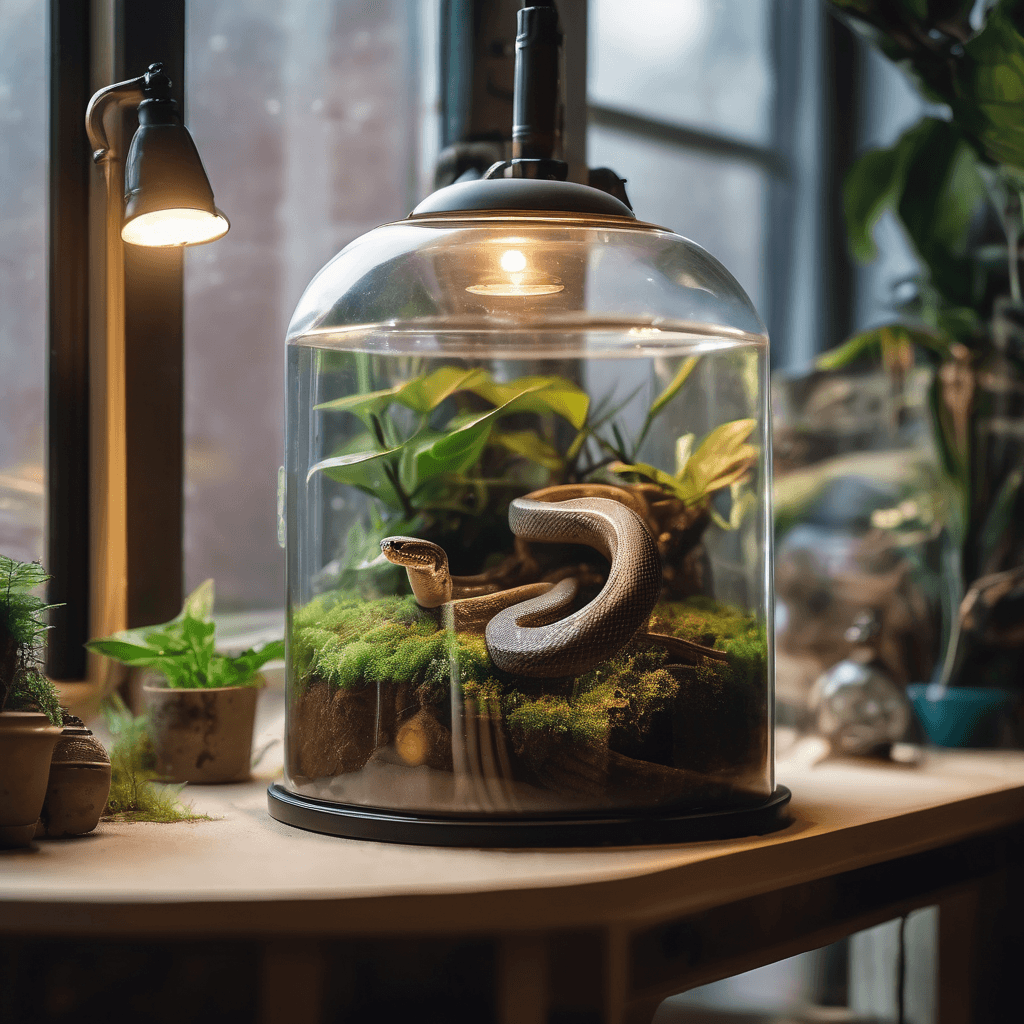
Why Snake Enclosures Fail
Most snake setups that go wrong share one trait: they were built around what looks good in a room instead of what the species needs in the wild. A ball python in a tall, sparse tank with a heat rock is the classic example — it is the setup every big-box store display suggests, and it is responsible for the majority of chronic health problems in captive ball pythons, from burns to chronic dehydration to refused feeds.
The good news is that a correct snake enclosure is simpler and cheaper than a decorative one. Snakes need five things: the right floor area, a thermal gradient, stable humidity, secure hides, and a way to measure both temperature and humidity accurately. Everything else — background, plants, branches — is optional. This guide walks through each of the five systems, with the species-specific numbers that matter, the setup mistakes that do the damage, and a checklist you can work through before the snake comes home.
This guide is part of our small pet reptile care series. For species profiles, see ball python care and corn snake care.
The Five Systems of a Snake Enclosure
Every snake enclosure, regardless of species, is built from the same five systems. The values change by species; the structure does not.
- Space — floor area and height appropriate to the species and the animal’s length.
- Heat — a warm side and a cool side creating a gradient the snake can move between.
- Humidity — a stable moisture level matched to the species, measured with a digital hygrometer.
- Hides — secure enclosed shelters on both the warm and cool sides.
- Monitoring — a digital thermometer probe and a digital hygrometer at snake level, not at the lid.
A keeper who gets all five right has solved ninety percent of snake keeping. Feeding, handling, and health problems nearly all trace back to one of these five being wrong.
System 1: Choosing the Enclosure Size
The floor-area rule
Snakes are ground-oriented animals. For terrestrial species like ball pythons, corn snakes, and kingsnakes, the rule of thumb is an enclosure whose floor area is at least equal to the snake’s length squared in simplified terms — practically, an adult ball python (3–5 ft / 1–1.5 m) is comfortable in a 4×2 ft (120×60 cm) front-opening terrarium. A corn snake does well in 4×2 ft as an adult, and a 3×2 ft (90×60 cm) works for a juvenile.
The common beginner mistake is height. A 20-gallon tall aquarium (30×12×12 in) is sold as a “snake tank” in every pet store, and it is wrong for a terrestrial species: the snake has almost no usable floor space and spends its life climbing glass it cannot grip. Horizontal enclosures beat tall ones for the majority of pet snake species.
Semi-arboreal species
Some species climb. Green tree pythons, emerald tree boas, and garter snakes that semi-climb benefit from vertical space and secure branches. For these, height matters — but the enclosure still needs enough width that the snake can coil. If you keep an arboreal species, pair height with a front-opening glass or mesh enclosure that lets the snake thermoregulate against a heated basking area.
Juveniles and the “too big” myth
The old advice that a large enclosure “stresses” a small snake is largely wrong for most colubrids and pythons. What a juvenile actually needs is clutter: extra hides, extra cover, a slightly more complex layout so the animal feels secure in the larger space. A hatchling in a bare 4×2 ft enclosure may refuse food; the same hatchling in the same enclosure with six hides and leaf litter covering the floor usually feeds within a week. The fix is enrichment, not a smaller box.
Enclosure types compared
| Type | Pros | Cons | Best for |
|---|---|---|---|
| Glass terrarium (front-opening) | Holds humidity well, secure lid, snakes visible | Heavy, more expensive, screens reduce humidity at the top | Ball pythons, most terrestrial species |
| PVC/plastic cages | Lightweight, excellent insulation, holds heat and humidity | Can be pricey, need a heat source on one end | Ball pythons, boas, breeding racks |
| Tub racks | Cheap, space-efficient, great humidity | Poor viewing, no vertical space | Keepers with multiple snakes |
| Mesh/aquariums | Inexpensive, easy to clean | Dries out fast, heat escapes through the top, glass unsafe for active snakes | Not recommended for humidity-dependent species |
Whichever you choose, the lid must lock. Snakes are escape artists, and an escaped snake inside wall cavities is the single most common way keepers lose an animal for good. Weigh the lid or use clips on every tank.
System 2: Heat and the Thermal Gradient
Why the gradient is non-negotiable
Snakes are ectotherms: they cannot generate their own body heat and regulate temperature by moving between warmer and cooler areas. A correct enclosure therefore has a warm side and a cool side — a gradient, not a uniform temperature. Without a gradient, the snake cannot cool down when it is digesting, cannot warm up to digest at all, and over months develops the chronic stress and immune suppression that lead to respiratory disease and anorexia.
Target temperatures by species
| Species | Warm side (basking) | Cool side | Night drop |
|---|---|---|---|
| Ball python | 88–92°F (31–33°C) | 76–80°F (24–27°C) | Not below 75°F (24°C) |
| Corn snake | 85–88°F (29–31°C) | 72–78°F (22–26°C) | 65–70°F (18–21°C) acceptable |
| King/milk snake | 84–88°F (29–31°C) | 70–75°F (21–24°C) | 65–68°F (18–20°C) |
| Boa constrictor | 88–92°F (31–33°C) | 76–80°F (24–27°C) | 75°F (24°C) |
| Garter snake | 84–86°F (29–30°C) | 70–75°F (21–24°C) | 65°F (18°C) |
Heat source options
Heat mats sit under one third of the enclosure floor and are the classic choice for glass tanks. They only warm the substrate they contact, so on a deep-substrate ball python enclosure a heat mat alone often cannot produce a usable surface temperature. If you use one, put it on a thermostat (see below) and never inside the enclosure where the snake can lie directly on it — that is how severe belly burns happen.
Ceramic heat emitters and heat bulbs screw into a dome fixture above the enclosure and warm the air inside. They pair with a deep-hot-spot setup and work well with a thermostat probe. For species needing a basking temperature (like some boas and pythons), an overhead heat source creates a more natural gradient than a mat.
Heat tape mounted on one side wall of a PVC cage produces an excellent side-to-side gradient and is the standard in serious collections. It is the option I recommend for ball pythons in plastic enclosures.
Heat rocks are not acceptable. The old-style “reptile heat rock” produces dangerously hot surface spots that burn snakes, which cannot feel localized heat the way mammals can. There is no safe way to use one. If you own one, throw it away.
Thermostats are mandatory, not optional
Every heat source must be on a thermostat. An unregulated heat mat can push surface temperatures well past 100°F (38°C) and will slowly cook the animal’s ventral scales. A cheap pulse-proportional thermostat with a probe placed on the warm-side substrate under the hide is the single most important purchase in snake keeping — more important than the enclosure itself. See our thermostat guide for how to set one up.
Lighting for snakes
Snakes do not require UVB the way diurnal lizards do, but low-level UVB (a 5.0 shaded fluorescent or a low-output bulb covering half the enclosure) is increasingly recommended by reptile veterinarians as supporting long-term bone health and natural behavior. What snakes do need is a consistent day-night cycle — 12 hours on, 12 hours off — so use a simple timer on any visible lighting. Never leave a bright light on the enclosure 24 hours a day; it causes chronic stress.
System 3: Humidity Done Right
What humidity does inside the enclosure
Humidity keeps the snake hydrated between drinks, supports proper shedding, and protects the respiratory tract. Too dry is the more common failure: retained shed (especially eye caps and tail tips), chronic dehydration, and a snake that refuses food because its nasal passages are uncomfortably dry. Too wet is the rarer but equally dangerous failure: scale rot, blister disease, and respiratory infections from constantly damp substrate.
Target humidity by species
| Species | Humidity | Notes |
|---|---|---|
| Ball python | 55–65% ambient, 70–80% in the humid hide | The most humidity-sensitive common pet snake |
| Corn snake | 40–55% | Moderate; too wet causes scale rot |
| King/milk snake | 40–60% | Moderate; a humid hide helps shed |
| Boa constrictor | 60–70% | Higher ambient than colubrids |
| Green tree python | 60–80% | Needs misting and excellent ventilation to avoid rot |
How to raise humidity correctly
The right way to raise humidity is to reduce ventilation and add moisture at the substrate level — not to soak the animal. Practical steps: cover three quarters of a mesh lid with a solid material (acrylic, taped cardboard), use a moisture-retaining substrate (coconut fiber, cypress mulch, or a soil mix — never plain newspaper for humidity species), and provide a humid hide: a closed plastic shelter with a hole cut in the top, filled with damp (not dripping) sphagnum moss. The snake chooses when to enter it, which is exactly how it should work.
Do not mist the entire enclosure daily to hit a number on the hygrometer. That swings humidity up and down and keeps the substrate surface constantly wet, which is what grows mold and bacteria. Raise the baseline, then let the humid hide do the work.
How to lower humidity correctly
If humidity runs too high: increase ventilation (larger mesh area on the lid), switch from a moisture-holding substrate to aspen or newspaper, move the water dish away from the warm side, and check that the heat source is not boiling off more moisture than expected. A corn snake in a sealed glass tank with coconut fiber will run 70% humidity and develop scale rot; the fix is substrate and airflow, not less water.
System 4: Hides and Enrichment
A snake without a hide it can fully enclose itself inside is a stressed snake. It will spend its life pushed against a wall or half-buried, refuse food, and become defensive when handled. Provide at least two hides — one on the warm side, one on the cool side — sized so the snake can curl up completely inside with contact against its body on all sides. A hide that is too big feels as insecure as no hide at all; add substrate or a smaller shelter inside a large hide to close the gap.
For burrowing species, the substrate itself is the hide. A ball python with 3–4 inches (7–10 cm) of loose substrate will make its own burrow and rarely use a plastic shelter. For arboreal species, elevated hides and secure branches do the same job. Match the hide type to the species’ natural behavior rather than defaulting to a plastic cave.
Beyond hides, simple enrichment helps: leaf litter over the substrate, a piece of cork bark to rub against during shed, and a varied feeding location that forces the snake to move and hunt. Snakes are not “simple” animals, and a barren box produces a behavioral animal.
System 5: Monitoring — the Instruments That Tell the Truth
You cannot manage what you do not measure, and in snake keeping, measuring means two instruments at snake level:
- A digital thermometer with a probe. Place the probe on the substrate of the warm side, directly under where the snake will bask. Not on the glass wall, not on the lid. Dial-type analog stick-on thermometers are consistently wrong by several degrees and cannot be trusted for the basking spot.
- A digital hygrometer. Place it at mid-height in the middle of the enclosure, out of the water dish splash zone. Cheap $5 analog hygrometers drift badly; a calibrated digital unit costs $10–15 and is worth it. If your humidity readings seem off, calibrate the sensor in a salt-slurry bag (the classic salt-test method) rather than guessing.
Log readings daily for the first two weeks. Once you know the enclosure’s daily swing — cool side morning temperature, warm side afternoon peak, humidity before and after misting — you can adjust the thermostat and ventilation with data instead of vibes.
Step-by-Step Setup Before the Snake Arrives
Build the enclosure and run it empty for at least a week before bringing a snake home. This is not fussiness: it proves the heat and humidity hold their values through a full daily cycle, and it gives you time to fix problems without a stressed animal in the box.
- Day 1: Assemble the enclosure, position the heat source on one end, install the thermostat, set the day-night light timer.
- Day 2: Add substrate and hides. Place the water dish on the cool side. Do not seal the enclosure yet.
- Days 3–7: Log temperature and humidity morning and evening. Adjust thermostat and ventilation until the warm-side target is hit and the cool side stays in range.
- Day 7: Values stable for three consecutive days? The enclosure is ready. Feed a thawed prey item to test your own handling routine if you want, or just proceed.
- Arrival day: Place the snake in the enclosure and leave it alone for 48 hours. No handling, no feeding attempts for a week. Darkness and quiet are what the animal needs to settle.
Common Setup Mistakes and Their Fixes
| Mistake | What it causes | Fix |
|---|---|---|
| Heat rock inside the enclosure | Severe ventral burns, thermal injury | Remove immediately; use a thermostatted mat or tape |
| Tall tank for a terrestrial species | Stress, climbing injuries, poor feeding | Switch to horizontal orientation |
| No thermostat | Overheating, chronic stress, burns | Install a probe thermostat — non-negotiable |
| Only one hide | Stress, feeding refusal, defensiveness | Add warm-side and cool-side hides |
| Daily full misting on a corn snake | Scale rot, blister disease | Raise baseline humidity; use a humid hide instead |
| Analog stick-on thermometer | Wrong temperature readings, wrong management | Digital probe thermometer at substrate level |
| Unlocked lid | Escapees | Locks or weights on every enclosure |
Warning Signs: When to Call a Reptile Vet
Most enclosure problems show up as behavior or appearance long before they become emergencies. These signs mean the environment needs fixing, and some mean the animal needs a vet — see our reptile warning signs guide and how to find a reptile vet for more detail.
- Wheezing, bubbles, or open-mouth breathing — respiratory infection, usually from cold and/or wet conditions. See a reptile vet within 24–48 hours; this does not resolve on its own.
- Repeated stuck shed, especially retained eye caps — chronic low humidity. Fix the environment first; if it persists after two sheds, have a vet check for underlying issues.
- Refusing food for three or more weeks (outside of breeding season, shed, or a recent move) — check husbandry against this guide line by line before assuming illness, but involve a vet if a healthy-looking snake refuses prey for a month.
- Regurgitation 24–72 hours after feeding — usually too-cold temperatures during digestion, but repeated episodes need veterinary assessment.
- Spending all its time on the cool side or pressed against the glass — the enclosure is too hot. Measure immediately.
- Reddish-brown discoloration or pustules on the belly scales — scale rot from chronically wet substrate. Requires vet treatment plus a full husbandry overhaul.
When in doubt, err on the side of the vet. A reptile appointment that finds nothing costs a consultation fee; a respiratory infection left untreated for two weeks can cost the animal.
Final Checklist
- Enclosure floor area matched to adult length; height appropriate to species behavior
- Locking lid verified
- Heat source on one end only, on a working thermostat with a substrate-level probe
- Warm side and cool side targets confirmed by daily log over one week
- Humidity target confirmed; humid hide provided for shedding species
- Two hides minimum (warm and cool), sized for full enclosure of the body
- Water dish on the cool side, large enough to soak in
- Digital thermometer AND digital hygrometer at snake level
- Day-night light cycle on a timer
- Enclosure cycled empty for a week; 48 hours of undisturbed rest after arrival
A well-built snake enclosure costs a few hundred dollars and lasts for the animal’s entire life — a corn snake kept properly lives 15–20 years, a ball python 20–30. The five systems in this guide are not optional refinements; they are the difference between an animal that thrives and one that slowly declines. Get space, heat, humidity, hides, and monitoring right, and feeding, handling, and health mostly take care of themselves.
Leave a Reply