
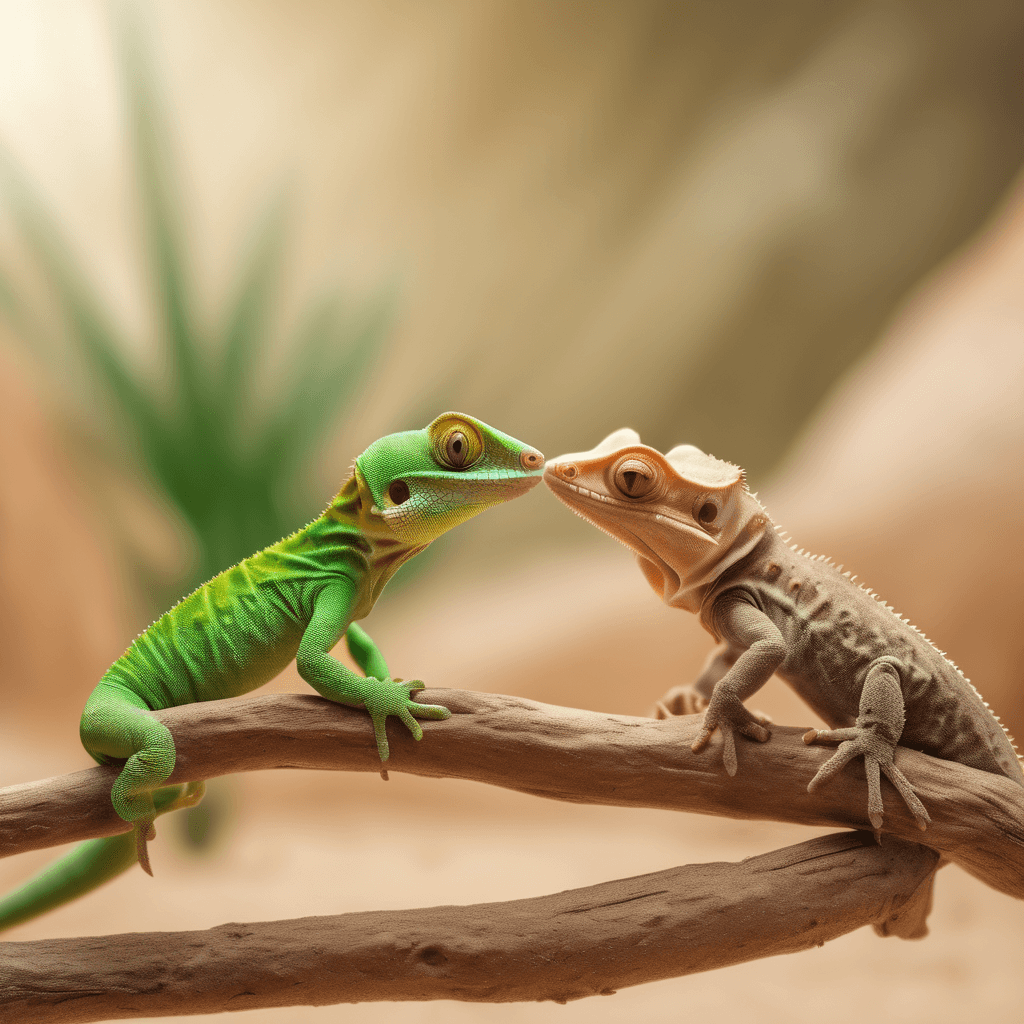
Ask ten keepers which gecko a beginner should buy and you will get both answers with total conviction. The leopard gecko is the safe, famous, universally recommended one — a desert ground-dweller that will live in your house for two decades. The crested gecko is the low-heat, watchable, slightly more fragile one — an arboreal New Caledonian that does not need a basking lamp and eats fruit.
Both are genuinely excellent pets. They solve completely different problems. This comparison puts them side by side across the seven factors that actually determine whether a setup will survive contact with your real life, not your aspirations.
If you have not yet chosen, read our leopard gecko setup guide and crested gecko care guide first — this page is a decision tool, those are the how-to manuals.
At a Glance
| Factor | Leopard Gecko | Crested Gecko |
|---|---|---|
| Origin | Arid rocky grassland, Afghanistan/Pakistan | Rainforest canopy, New Caledonia |
| Adult size | 8–10 inches | 8–10 inches plus tail |
| Lifespan | 15–20 years | 15–20 years with good care |
| Habitat type | Terrestrial, ground-dwelling | Arboreal, climbing |
| Heat | Basking spot needed (~32°C surface) | Room temperature, no basking required |
| Humidity | 30–40%, humid hide for shedding | 60–80% consistently |
| Diet | Insects, dusted with calcium | Powdered fruit/insect diet plus live insects |
| UVB | Low output beneficial | Low output beneficial |
| Temperament | Calm, slow, tolerant of handling | Jumpy, can jump; handling needs care |
| Tail | Fat-storage, never detaches cleanly | Semi-prehensile, detaches if grabbed |
| Beginner difficulty | Very easy | Easy, but heat-free means temperature discipline matters more |
| Typical setup cost | Higher (heat + thermostat) | Lower (no heat equipment) |
1. Enclosure: Floor Space vs Height
This is the biggest structural difference and the one that decides where the tank goes in your home.
A leopard gecko is a floor animal. It needs horizontal space to patrol and a warm ground patch to lie on. A 40-gallon breeder tank (roughly 90×45cm footprint) is the sweet spot for one adult — long, not tall. Vertical space is irrelevant; you can fill a tall tank with substrate and the gecko will never climb the walls. Glass terraria with front-opening doors work perfectly.
A crested gecko is a canopy animal. It needs height and branches, and it will spend nearly all its time above the halfway line. A vertically-oriented enclosure — the popular 45×45×60cm glass cubes, or a mesh-fronted vertical viv — is the correct shape. Floor space matters far less than climbable structure. A wide, shallow tank is a genuinely poor crested gecko home no matter how well it is decorated.
Verdict: if you have a long, low space, buy a leopard gecko. If you have a tall, narrow space or want something visually interesting on a bookshelf, buy a crested gecko. Trying to run the wrong species in the wrong shape is the most common early mistake with both.
2. Heat and Humidity — Opposites
The leopard gecko is a desert animal with a basking requirement. It needs a warm ground patch of roughly 32°C surface temperature during the day and a cool end around 24°C, with a night drop. That means a heat mat or a low-wattage deep heat projector, a thermostat, and two thermometers. Our thermostat guide covers the hardware; the point here is that heat is non-negotiable equipment for a leopard gecko, and it can fail in ways that kill the animal (a stuck heat mat in summer is a real risk).
The crested gecko needs none of that. Its comfortable range is ordinary room temperature, 22–26°C, and it tolerates a slightly wider band. No basking bulb, no thermostat, no heat-related failure modes. What it does need is high, stable humidity — 60–80% for most of the day, with a misting routine morning and evening. In a dry apartment or a heated winter room, humidity is the hard part, not temperature.
Verdict: leopard gecko = you must buy and maintain heat equipment. Crested gecko = you must commit to misting twice a day, every day, for fifteen years. The crested is cheaper to start and arguably harder to sustain long-term, because a missed misting day in winter is a real welfare problem, whereas a thermostat is set-and-forget.
3. Diet — Insects vs Powder
Leopard geckos eat live insects, and you will be running an insect colony or buying regular deliveries. Crickets, mealworms, dubia roaches, black soldier fly larvae. Every insect gets dusted with calcium powder before it goes in the tank. The upside is control — you see exactly what the animal ate and how much. The downside is the fridge of insects and the dusting routine, and the fact that an insect-only diet is monotonous.
Crested geckos eat a powdered diet mixed with water into a paste — the standard product is a fruit-and-insect meal replacement that contains everything they need. You mix a small amount, put it in a wall-mounted cup, and replace it every two days. Live insects are optional enrichment, not a nutritional requirement. The upside is almost zero maintenance: a cup of food lasts two days, and there is no colony to maintain. The downside is you cannot see how much the animal ate, and a gecko that is off its food can quietly under-eat for days.
Verdict: crested gecko wins decisively on day-to-day effort. Leopard gecko wins on dietary transparency and the fact that your lizard visibly hunts. If you cannot stomach keeping insects, do not buy a leopard gecko.
4. Handling and Temperament
Leopard geckos are famously docile. They are slow, they do not bite, and they will sit in a hand or crawl along a sleeve without much drama. Handling tolerance is one of their genuine strengths and a large part of why they are the default recommendation. They do not like being grabbed from above — predators come from above in their world — so approach from the side and let them walk onto your hand.
Crested geckos are the opposite personality. They are fast, alert, and inclined to jump when startled, which in a living room means they land on the floor. They tolerate handling well once accustomed, but they need handling over a surface, not held up in the air, and their tails are semi-prehensile — a startled crested that is held by the tail will drop it. The tail does not grow back. They also shed their skin in one piece and eat it, which new keepers occasionally find alarming.
Verdict: leopard gecko for a first reptile and for children. Crested gecko for someone who wants an interesting animal to watch more than one to hold constantly.
5. Health and Veterinary Risk
Both species are robust when kept correctly. Both have species-specific failure points.
Leopard geckos are prone to metabolic bone disease when UVB and calcium are neglected, impaction from loose substrate (sand is a known risk for juveniles), and dysecdysis (stuck shed) when humidity is too low. They are also long-lived enough that age-related issues — egg-binding in females, fatty liver in overfed animals — become real over a fifteen-to-twenty-year span.
Crested geckos are sensitive to heat. Above roughly 29°C ambient for any length of time they become stressed and can die. This is the species’ one hard limit and the reason heat-free housing is actually a safety feature. They are also prone to dehydration if misting lapses, and to metabolic bone disease despite being easier to feed correctly — the powder diet approach works only if you actually mix and replace it. Floppy tail syndrome, a harmless-but-permanent cartilage issue, is common in geckos that spend too much time resting upside down on glass.
Both species need a reptile-experienced vet identified before there is an emergency. Our guide to choosing a reptile vet applies to either choice.
6. Lifespan and Commitment
Call this a tie, and it is an important one. Both species commonly reach 15–20 years in captivity with correct care. That is longer than most dogs. A gecko bought for a ten-year-old will plausibly still be alive when that child leaves home. Decide that you want a fifteen-plus-year animal before you buy either species; if you are not sure, volunteer at a rescue or foster rather than buying.
7. Cost Comparison
- Leopard gecko initial: enclosure (~$150–300 for a 40-gal breeder), heat mat + thermostat (~$60–120), UVB bulb + fixture (~$50), hides and decor (~$60), substrate (~$20). Higher up-front total, low ongoing.
- Crested gecko initial: vertical enclosure (~$150–300), no heat equipment, UVB bulb + fixture (~$50), branches and foliage (~$60), substrate (~$20), food (~$15). Lower up-front total.
- Ongoing, both: food is the main line item. Leopard gecko insects cost more than crested gecko powder over a year. Electricity for the leopard gecko’s heat mat is modest but real.
Verdict: crested gecko is cheaper to start and cheaper to feed. Leopard gecko costs more up front and more per month.
Which Should You Actually Buy?
Buy a leopard gecko if:
- You want a reptile you can handle regularly and calmly
- You have (or will buy) the space for a long, low enclosure
- You are comfortable maintaining a live insect supply or regular deliveries
- You want the classic, well-documented, endlessly-supported beginner species
- You are buying for a child’s first reptile
- You are in a cool room and already need to buy heating anyway
Buy a crested gecko if:
- You cannot or will not keep live insects
- You want a tall, visually interesting display enclosure
- Your home is reliably at room temperature (22–26°C) year-round
- You will genuinely mist twice a day, including weekends and holidays
- You prefer watching to holding
- You want the lowest equipment-complexity reptile that is still undeniably a reptile
Honest answer for most first-time keepers: the leopard gecko, because its one hard requirement (heat) is solvable with a thermostat you set once, while the crested gecko’s hard requirement (daily misting) depends on you never having a chaotic fortnight. Equipment fails predictably; routines fail unpredictably. The species whose safety does not depend on your routine is the safer first animal.
Warning Signs in Either Species
- Leopard gecko: soft or bent jaw, limb tremors, swollen legs (calcium deficiency); stuck shed on toes and tail (humidity too low); refusal to eat with a cold enclosure (heat failure); tail thinner than the neck (underfed or ill).
- Crested gecko: open-mouth breathing, gaping, lethargy, or hiding in the coolest spot for long periods (too hot — move the enclosure immediately); sunken eyes and wrinkled skin (dehydration — mist now and check routine); regurgitated food (temperature too high or stress).
Any of these warrants a vet visit rather than a forum post. Our reptile warning signs guide covers what to bring and what to say.
Frequently Asked Questions
Can I keep a leopard gecko and a crested gecko together?
No. Different temperature, humidity, and dietary requirements, and geckos are not social species. One enclosure per animal, always.
Which is better for a child?
The leopard gecko, by a clear margin. It is slower, calmer, does not jump, and tolerates handling. A crested gecko can leap out of a child’s hands and its tail can detach.
Do crested geckos really need no heat at all?
They need no heat in a home that stays between 22 and 26°C. In a house that drops below 18°C in winter or rises above 29°C in summer, you need to either condition the room or provide controlled low-level heat. “No heat” assumes a temperate room.
Are leopard geckos nocturnal? Will I ever see mine?
They are crepuscular — most active at dawn and dusk. They will be visible and active during evening hours, and they do come out during the day to bask. This is one reason low-output UVB and a predictable light cycle matter for them.
Can crested geckos regrow their tails?
No. The tail detaches as a defence and does not regenerate. This is why they should never be held by the tail, and why handling over a soft surface matters.
Which lives longer?
Statistically they are close, both commonly 15–20 years. The differentiator is care quality, not species. A badly kept crested gecko exposed to heat may live five years; a well kept one lives two decades.
The Bottom Line
Both geckos are excellent, and both will be a fifteen-to-twenty-year commitment. The leopard gecko trades daily effort for equipment complexity; the crested gecko trades equipment for daily routine. Pick the species whose failure mode you can actually live with — a thermostat you set once, or a misting bottle you pick up twice a day for the next fifteen years — and either choice will give you a healthy, long-lived, genuinely fascinating animal.
For more on building the enclosure itself, see our humidity guide, our equipment guide, and our guide to UVB lighting.
Leave a Reply